
PART 2:
The scent of old leather and machine oil wafted up as Arthur flipped through the yellowed pages of his address book.
Names like Hank “Iron” Miller, Big Pete, and Tommy “Two-Hammer” appeared alongside seven-digit phone numbers from the nineteen-eighties.
Late afternoon sunlight slanted through the windowpane, illuminating the worn notches along a brass measuring tape mounted on the wall—the same tape that had hung by his side since his first day on a job site.
He picked up the landline receiver and dialed Hank Miller—a retired ironworker who had helped him frame the Chatham County Courthouse.
“Hank here,” a booming voice growled through the speaker, thick with pipe tobacco.
“It’s Arthur, Hank. I need you to look into something for me at the county planning office.”
“Art? Haven’t heard from you in a year. What’s going on?”
Arthur pressed his thumb hard against the wooden edge of the desk, feeling the grain of every scratch.
“SunCoast Holdings LLC. Find out who’s behind the site-clearing permit application for my address.”
A long silence stretched across the line, filled only by the click of the Zippo lighter Hank always carried.
“Give me an hour, Art. I’ll call you back.”
Arthur hung up and walked over to the small Sentry safe tucked away in the back of his closet.
The door was resting slightly ajar.
When he pulled it open, it wasn’t just the velvet box containing Eleanor’s solitaire diamond ring that was missing—his life insurance folder was gone too.
Yet beneath the felt lining, tucked into a tear in the back corner, Arthur spotted a small folded slip of paper.
It wasn’t his document.
It was a bank transfer receipt from a private institution at Five Points in Atlanta, dated just three weeks ago.
The beneficiary wasn’t a real estate corporation.
It was an individual name: Evelyn Vance.
The sight of it squeezed Arthur’s chest like a tightening steel band.
Evelyn was his eldest daughter—the sister Julian had sworn he cut ties with ten years ago after a bitter family dispute.
The sharp ring of the landline shattered the heavy silence in the bedroom.
Arthur walked back to the living room and picked up.
“Art, it’s Hank,” the ironworker said, his earlier warmth replaced by a tense hesitation. “I checked with the planning department. SunCoast didn’t buy your house to knock it down for commercial zoning.”
“What do you mean?”
“The petition to rezone was frozen. But it gets worse, Art… SunCoast just filed an emergency foreclosure notice. Your place was put up as collateral for an overdue one-million-dollar private loan. And that note… it bears your thumbprint signature from six months ago.”
Arthur went rigid, the receiver trembling in his grip.
Six months ago, he was lying in a bed at St. Joseph’s Hospital following a minor stroke.
The only person sitting by his bedside, holding his hand every night, had been Julian.
PART 3:
The morning sun bled through the live oaks, casting cage-like shadows across the porch steps.
Arthur sat at his oak dining table, the brass measuring tape held flat under his left palm while his right hand traced the ink on a fresh county land survey.
Across from him, Hank “Iron” Miller set down a heavy ceramic mug of black coffee, the dark liquid swirling against the rim.
“The paper trail is a maze, Art,” Hank said, resting his thick forearms on the table. “SunCoast Holdings isn’t an investment firm—it’s a shell company registered in Delaware, funded by a private hard-money lender operating out of North Atlanta.”
Arthur didn’t look up from the blueprints.
“Julian didn’t sell the house,” Arthur said softly, his thumb resting over the faded ink of his own signature on the original foundation plot. “He pledged it.”
“He used your medical power of attorney while you were sedated at St. Joseph’s,” Hank replied, his voice dropping an octave. “He put up this land to cover a short-term loan for a failing luxury condo project in Chicago. When the market dipped, the lender called the note.”
Before Arthur could speak, the gravel driveway crunched beneath the tires of a sleek black sedan.
A man in a sharp charcoal suit stepped out, holding a leather clipboard under his arm as he walked up the path with measured, predatory steps.
Arthur rose slowly, stepping onto the porch as the man stopped at the bottom of the wooden stairs.
“Mr. Vance?” the man asked, adjusting his sunglasses. “I’m Marcus Cole, representing SunCoast Holdings. I’m here to conduct the preliminary structural inspection ahead of the thirty-day vacate order.”
Arthur stood at the top step, his weathered frame blocking the doorway.
“You’re on private property, Mr. Cole.”
“Not anymore,” Cole said, pulling a laminated document from his clipboard. “The court granted us immediate access for valuation purposes. If you obstruct this inspection, Chatham County sheriffs will assist us.”
Arthur looked at the man’s polished shoes, then down at the third stair tread—a piece of heart-pine he had cured and installed himself thirty-five years ago.
“You see that riser?” Arthur pointed with his calloused index finger. “I built this entire house on poured concrete piers anchored four feet into stable clay, long before county codes required it. Under Georgia code section 44, any entity seeking structural valuation on a contested mortgage encumbrance must provide a certified engineer’s seal forty-eight hours prior.”
Cole paused, his hand freezing on his clipboard.
“You don’t have an engineering seal on that clipboard, son,” Arthur said quietly, stepping down one stair. “And until you do, if your shoes touch my porch again, I’ll have Deputy Sheriff Miller—Hank’s nephew—cite you for criminal trespass.”
Cole stared at the old man, the smug confidence slipping from his jaw line.
He slowly backed toward his car, pointing a finger.
“Thirty days, Vance. That clock is ticking down to zero.”
Arthur watched the sedan back out of the driveway, the dust settling over the dry grass.
“Nice bluff, Art,” Hank muttered, stepping out beside him.
“It wasn’t a bluff,” Arthur said, turning back toward the house. “It just bought us forty-eight hours. Call Tommy Two-Hammer. Tell him I need his truck, three kegs of framing nails, and every retired union carpenter in the county.”
PART 4:
By midnight, the air inside the living room smelled of burnt coffee and stale cigar smoke.
Arthur sat alone under the warm glow of a brass desk lamp, the leather-bound address book open next to a stack of old bank statements he’d dragged out from the attic.
The bank transfer receipt to Evelyn sat right in the center of the desk.
He picked up the landline handset and dialed a long-distance number he hadn’t used in a decade.
The line rang four times before a woman answered, her voice tired and cautious.
“Hello?”
“Evelyn,” Arthur said.
A heavy silence fell across the wire, thick with ten years of unsaid words and unspoken grief.
“Dad?” she whispered. “Why are you calling me?”
“I found the transfer receipt, Evelyn. Three weeks ago. From Julian.”
He heard her take a sharp breath on the other end.
“Dad… you don’t know what happened.”
“I know he forged my mark while I was in a hospital bed,” Arthur said, his voice straining against the tightness in his throat. “I know he put Eleanor’s home on the line for a million dollars. And I know he sent money to you while he was running from me.”
“He didn’t run to Chicago to abandon you, Dad!” Evelyn’s voice cracked, dropping into an urgent whisper. “He ran because he was drowning. Julian didn’t take out that loan for a condo project. He took it out five years ago to pay for Mom’s experimental cancer treatment in Boston—the one insurance refused to cover!”
Arthur felt the air leave his lungs as if he’d been struck in the chest with a framing hammer.
“What are you talking about?” Arthur asked, his hand gripping the receiver until his knuckles turned ivory. “Eleanor’s care was covered by Medicare and my union annuity.”
“It didn’t cover half of it,” Evelyn sobbed softly. “Mom made Julian promise never to tell you. You were working sixty hours a week on site, blowing out your knees just to keep up with the mortgage. She knew your pride would break if you lost this house back then. So Julian took out private notes behind your back to keep her alive for those extra two years.”
The room seemed to shrink around Arthur, the familiar walls suddenly feeling cold and foreign.
“He hid it for years, Dad,” Evelyn continued. “He tried to fix it on his own through financial trading, but the interest stacked up. The lenders threatened to go after you directly. The only way he could shield you was to transfer the deed to a holding company, stall the foreclosure, and draw the lenders’ heat toward himself in Chicago.”
Arthur looked at the oak dining table in the adjoining room—the table where Julian had smiled and poured Cabernet just nine months ago.
“Where is he, Evelyn?” Arthur asked, his voice shaking.
“He’s at a motel near the railyards in West Chicago,” she said quietly. “He sold Mom’s ring to pay off the first tranche of interest so they wouldn’t send collectors to your door this month. He has nothing left, Dad.”
Arthur lowered the phone, the hum of the dial tone echoing through the empty hallway.
He looked down at his calloused hands—the hands he thought had protected his family for half a century, only to realize he had been blind to the weight his son was carrying alone.
He reached for his old leather address book, turning to a page he hadn’t looked at in twenty years.
PART 5:
The morning air smelled of sawdust and diesel exhaust.
A rusted red Ford F-350 pulled into the gravel driveway, hauling a flatbed trailer stacked high with yellowing pine framing lumber and heavy steel jack-posts.
Tommy “Two-Hammer” stepped out of the cab, his silver hair tucked under a faded blue carpenter’s union cap, accompanied by three other retired tradesmen whose faces Arthur knew from forty years on high-rise scaffolds.
“You called for a framing crew, Art?” Tommy asked, slamming the truck door shut.
Arthur walked down the porch steps, his old leather tool belt slung over his shoulder like a faded piece of armor.
“We aren’t building a new house, Tommy,” Arthur said, adjusting the brass tape measure on his hip. “We’re reinforcing a fortress.”
Before Tommy could unfasten the tie-down straps on the flatbed, a low-slung rental sedan kicked up a cloud of dust as it screeched to a halt behind the trailer.
The driver’s door flew open.
Julian stepped out.
He wore a crumpled linen shirt, his eyes bloodshot and surrounded by dark circles, his skin pale under the Georgia sun.
“Dad!” Julian shouted, stumbling slightly as his dress shoes caught on the gravel. “What are you doing? Who are these people?”
Arthur stood motionless on the porch, his eyes locking onto his son’s exhausted face.
“You’re late for Thanksgiving, Julian,” Arthur said softly.
Julian froze ten feet away, his jaw working silently before he looked down at the ground.
“Evelyn called me,” Julian muttered, his voice cracking. “She told me you found the transfer stub. Dad… you have to get these men off the property. Marcus Cole and his people aren’t just corporate suits. The lenders behind SunCoast are dangerous. They will seize this land by force if they have to.”
“Let them try,” Tommy yelled from the flatbed, holding a forty-ounce framing hammer across his chest.
“Shut up, old man!” Julian snapped, rounding on Tommy with a desperation that turned his voice into a sharp plea. “You don’t understand! I signed a confession of judgment! If the foreclosure doesn’t go through by Friday, they’re filing criminal fraud charges against me for signing Dad’s name on the deed!”
The yard went deathly quiet, save for the hum of cicadas in the Spanish moss overhead.
Arthur stepped off the bottom stair, his work boots sinking into the dry soil.
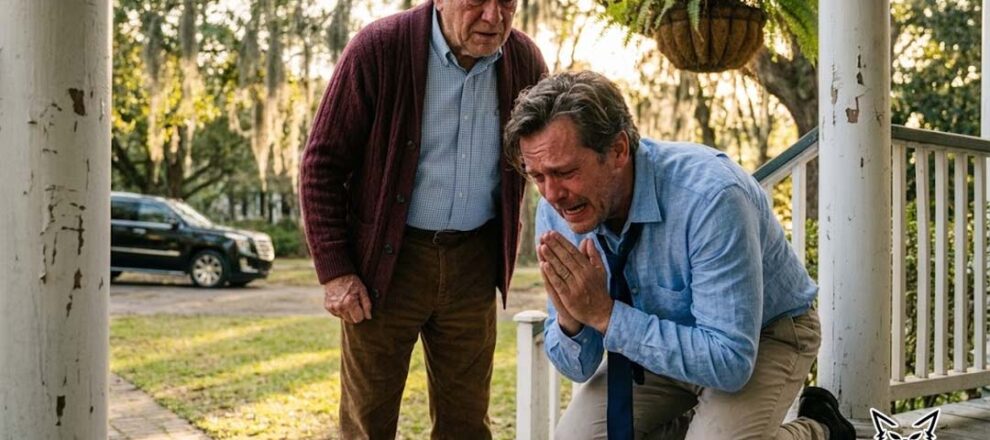
“You signed my thumbprint while I was unconscious in St. Joseph’s,” Arthur said, stopping three feet from his son.
“I had to!” Julian cried out, tears cutting clean tracks through the dust on his cheeks. “The Boston clinic was going to pull Mom off the clinical trial! She was crying in pain every night, Dad! You were working sixteen-hour shifts, coming home with bleeding palms, pretending everything was fine! You would have sold this house back in 2018 and lived in a trailer just to buy her six more months! I couldn’t let you destroy yourself!”
“So you destroyed yourself instead?” Arthur asked, his voice dropping to a low, gravelly whisper.
Julian turned his face away, his chest heaving as he covered his eyes with a trembling hand.
“I thought I could fix it,” Julian sobbed. “I thought if I took the Chicago job, I could make enough on commissions to pay off the note before you ever found out. But the market crashed, Dad. I lost everything. I sold Mom’s ring to buy you three more weeks in this house.”
The crunch of heavy tires echoed from the road as two dark SUVs turned into the driveway, blocking the exit.
PART 6:
Marcus Cole stepped out of the lead SUV, flanked by two broad-shouldered men in dark tactical windbreakers.
He held a red folder in his hand, a cold smirk playing across his lips.
“Well, look at this,” Cole said, stepping onto the grass. “A family reunion right on top of our collateral.”
Julian immediately stepped in front of Arthur, spreading his arms. “Cole, talk to me. Leave my father out of this. He didn’t sign anything!”
“Shut up, Vance,” Cole said, opening the red folder. “Your father’s thumbprint is notarized on the deed assignment. Whether he was awake or asleep doesn’t matter to the court today—the title belongs to SunCoast Holdings LLC. We have an emergency court order for immediate possession due to waste and unauthorized construction.”
Cole gestured toward Tommy’s truck loaded with timber.
“You have ten minutes to clear out, old man,” Cole said, looking directly at Arthur. “Or my men will assist you into the back of a squad car for criminal obstruction.”
Arthur looked at Cole, then down at the red folder in the man’s hand.
He reached into his cardigan pocket and pulled out his old leather-bound address book, flipping it open to a page containing a single laminated card.
“You see this card, Mr. Cole?” Arthur asked, his voice calm and steady. “This is my Master Carpenter License from the State of Georgia, issued in 1974.”
Cole sneered. “That piece of plastic doesn’t override a foreclosure deed.”
“No,” Arthur replied, stepping past Julian toward the edge of the porch. “But Georgia Code Section 44-14-361 gives any licensed contractor who performs uncompensated structural repairs on a residential property an automatic, primary Mechanic’s Lien over all existing mortgages.”
Cole’s smile faded slightly. “You haven’t built anything here in twenty years.”
“That’s where you’re wrong,” Tommy called out, hopping off the flatbed trailer with a battery-powered nail gun in his hand. “Art filed an emergency notice of structural restoration with the county clerk at eight o’clock this morning. We’re installing eighteen steel load-bearing piers under this foundation today.”
“A Mechanic’s Lien takes legal priority over your private mortgage note, Cole,” Arthur said, his eyes burning with an unyielding grit. “Which means if you want to foreclose on this land, SunCoast has to pay my crew three hundred thousand dollars in cash for structural labor before you can touch a single brick.”
Cole turned to his associates, his jaw tightening. “Call our attorneys. Now.”
“Wait,” Julian interjected, his voice trembling as he looked at Arthur with sheer terror. “Dad… if you file that lien, SunCoast will immediately hand my signed confession to the District Attorney. They will arrest me for grand larceny before the sun sets today.”
Arthur looked at his son—the boy he had raised to be strong, the man who had secretly broken his own life to spare his father’s heart.
The choice hung in the humid afternoon air like a suspended executioner’s blade:
Enforce the lien to save the ancestral home and watch his son go to federal prison… or surrender the key to SunCoast and walk away into the dark together.
PART 7:
The wind dropped, leaving the Georgia heat to settle over the yard like a wet wool blanket.
Marcus Cole leaned against his sedan, his cell phone pressed to his ear as he listened to SunCoast’s corporate counsel in Atlanta.
His face grew paler with every passing second.
“I don’t care about the Mechanic’s Lien!” Cole barked into the phone. “He’s seventy-eight years old! Just get an injunction!”
He went quiet, listening to the sharp, panicked voice on the other end.
Finally, Cole snapped the phone shut and glared at Arthur.
“You think you’re clever, old man?” Cole spat. “Our lawyers checked the registry. Your lien holds for now, but the moment we hand Julian’s fraudulent deed to the Chatham County DA, your son gets pulled out of here in handcuffs. He’ll do ten years in Reidsville State Prison.”
Julian collapsed onto the bottom porch step, his head buried in his hands, his shoulders shaking silently.
“Do it,” Arthur said.
Julian shot his head up, his eyes wide with shock. “Dad… no…”
“Do it, Mr. Cole,” Arthur repeated, stepping closer until he was standing right in front of Cole. “File the criminal charges. Hand the deed over to the DA. But make sure your lawyers include the hospital intake logs from St. Joseph’s on the night that thumbprint was taken.”
Cole hesitated, his eyes narrowing. “What are you talking about?”
“On the night Julian put my thumb on that paper, I was under heavy sedation with a blood alcohol and medical clearance report filed by Dr. Harrison,” Arthur said, his voice dropping into a razor-sharp growl. “A forgery case means a full discovery trial. And during discovery, my attorneys will subpoena every transaction SunCoast has made in Georgia over the last seven years—including your illegal short-term lending rates that break state usury laws.”
Cole stared at Arthur, his mouth opening slightly.
He looked at Tommy and the four retired carpenters holding framing hammers, then back at the old man whose eyes were as hard as cured concrete.
“You’re bluffing,” Cole whispered, though his hand trembled as he gripped his red folder.
“I spent forty years measuring load-bearing walls, son,” Arthur said softly. “I know exactly where a structure is weak. And your company is built on rotten studs.”
Cole swallowed hard.
He turned to his men, motioning toward the SUVs.
“We’re filing the fraud notice,” Cole lied, his voice lacking any real conviction as he backed toward his car. “You’ll hear from our attorneys by morning.”
“I’ll be right here on my porch,” Arthur called out as the black vehicles kicked up gravel, backing down the driveway and disappearing down the marsh road.
Silence returned to the yard.
Tommy set his nail gun down on the flatbed and looked at Arthur. “You want us to start unloading the timber, Art?”
Arthur looked down at Julian, who was still sitting on the wooden step, weeping quietly into his hands.
“No, Tommy,” Arthur said, his shoulders finally relaxing as he unbuckled his old leather tool belt. “Take the lumber back to the yard. The house is safe.”
He walked over to his son, unhooked the brass measuring tape from his belt, and set it down on the stair beside Julian.
“Get up, son,” Arthur said gently. “We have to go to Atlanta to see your sister.”
PART 8:
Three months later.
The crisp air of late autumn swept through Savannah, carrying the sharp scent of fallen oak leaves and salt water from the river.
The porch of the old house was newly painted, the white trim gleaming under the warm November sun.
On the side table sat a fresh dish of peach cobbler, left by Clara earlier that afternoon.
Arthur sat in his woven wicker rocker, listening to the rhythmic thump-thump of a hammer coming from the backyard.
He wrapped his cardigan tighter around his chest and stood up, walking slowly around the side of the porch to look out over the lawn.
Near the ancient live oak, Julian was crouched in the grass, lining up a two-by-four board along a fresh wooden frame.
Beside him sat a newly delivered toolbox, shiny and silver in the sunlight.
Evelyn walked out from the kitchen back door, holding two mugs of steaming cider.
She smiled at her father, handing him one mug before stepping down to give the other to her brother.
The legal battle with SunCoast had ended in a quiet, mediated settlement.
Faced with a high-stakes usury investigation and a contested Mechanic’s Lien, the lender had agreed to restructure the original debt into an affordable twenty-year mortgage, wiping out the fraudulent transfer completely.
Julian’s Chicago firm was a thing of the past, but he had moved back to Savannah, taking a job as an estimator for a local restoration contractor.
Julian wiped the sweat from his forehead with the back of his sleeve and looked up as his father walked over.
“How’s the alignment, Dad?” Julian asked, pointing to the wooden frame on the ground. “I’m building a shed for your extra tools.”
Arthur stopped at the edge of the frame.
He reached into his pocket, pulled out the worn brass measuring tape he had carried for half a century, and knelt down on one knee—his joints popping softly in the cool afternoon air.
He hooked the metal lip of the tape over the edge of the timber and pulled it tight, checking the notch.
“You’re an eighth of an inch off on the corner, Julian,” Arthur said, a faint, warm smile tugging at the corner of his mouth.
Julian laughed softly, taking the hammer from his belt. “Show me how to fix it.”
Arthur took the handle of the hammer, feeling the familiar weight in his calloused palm—the palm that had built a home, protected a family, and held fast against the storm.
“Hold it right here,” Arthur murmured, placing his hand over his son’s fingers. “Measure twice. Cut once.”
Above them, the moss-draped branches of the ancient live oaks swayed gently in the Georgia breeze, rooted deep into the earth, enduring as they always had.