
PART 2:
The morning air smelled of wet asphalt and dying maple leaves as Arthur stood by the hallway bannister, holding a small canvas duffel bag.
Julian stood near the open front door, the cool October breeze blowing inside, rustling the loose junk mail on the entryway console.
“It’s just a long weekend, Dad, three nights tops,” Julian said, taking the duffel bag from Arthur’s hand with an overeager tug.
“The main water line beneath the foundation is corroded, and the crew needs to shut off the water completely while they jackhammer the basement floor.”
Arthur pulled his heavy tweed coat tighter around his chest, his fingers instinctively slipping into his right pocket to clasp the round shape of his pocket watch.
“I could stay at the Hemingsons next door, Julian,” Arthur said, looking toward the radiator that had kept the hallway warm for forty years. “I don’t need a hotel.”
“Mrs. Hemingson is eighty-two and recovering from hip surgery, Dad, you’d be a burden,” Julian said smoothly, guiding Arthur by the elbow toward the waiting Lincoln Town Car in the driveway.
“Oakridge has full guest suites with room service, a private bath, and a TV—it’s more like a bed-and-breakfast while the contractor works.”
Arthur paused on the top step of the porch, his eyes trailing over the freshly painted white railings he had hand-sanded with his late wife back in the summer of ’88.
A small strip of yellow industrial tape hung loosely from the bottom step, fluttering in the cold autumn wind.
“Why is there a lockbox on the side door knob, son?” Arthur asked, pointing his thin finger toward the copper-colored box hanging from the bronze hardware.
Julian didn’t turn his head to look, his grip on Arthur’s arm tightening just enough to push him gently down the next step.
“Security code for the plumbing contractors, Dad,” Julian replied instantly, his voice flat and efficient. “So they don’t have to keep bothering us for keys.”
Arthur let himself be led into the passenger seat, the smell of cheap pine air freshener and faint tobacco smoke inside the sedan making his nose sting.
As Julian walked around the trunk to load the canvas bag, Arthur pulled out his brass watch, clicking the latch open with his thumb.
Inside the cover, the small, faded photograph of Mary standing on their porch gaped back at him, her smile framed by young oak saplings.
Julian opened the driver’s side door, catching sight of the vintage timepiece in his father’s hands, and his posture froze for a fraction of a second before he slid into the leather seat.
“You really don’t need to carry that old thing everywhere, Dad,” Julian said, staring straight ahead at the windshield as he cranked the ignition. “It’s outdated.”
Arthur slowly closed the brass cover with a soft, metallic snap, slipping it back into his tweed coat pocket.
“It keeps the exact time it was built to keep, Julian,” Arthur said, looking out the side window as the car pulled away from the curb.
Behind them, through the rear glass, Arthur watched a white van with blacked-out windows pull into his driveway, a man in work boots carrying a clipboard up the front steps toward Mary’s flower beds.
PART 3:
Three months later, rain streaked the cold double-paned window of Room 204 at the Oakridge Assisted Living Facility.
The air inside smelled faintly of industrial pine cleaner, boiled broccoli, and the stale, dry heat radiating from a baseboard unit near the floor.
Arthur sat upright on the edge of the narrow twin bed, wearing the same faded tweed jacket, his hands resting flat against his knees.
On the laminate nightstand beside him sat a plastic cup of water, a plastic pill organizer, and his heavy brass pocket watch, its chain coiled like a dead snake on the cold surface.
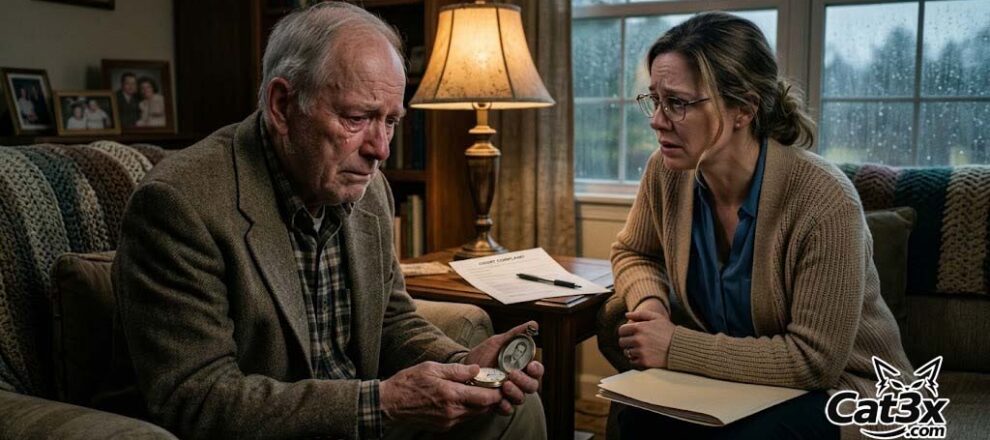
A quiet knock echoed at the hollow core door, and Sarah Jenkins stepped inside, holding a thick manila folder against her beige cardigan.
“Arthur?” Sarah said softy, her voice carrying a practiced, tender caution as she stepped around two stacked cardboard boxes in the corner. “I brought your evening vitamins.”
Arthur didn’t move his gaze from the grey parking lot three floors below, where streetlights flickered against the wet asphalt.
“Did he call, Sarah?” Arthur asked, his voice paper-thin, stripped of its old classroom cadence.
Sarah pulled a lightweight metal folding chair closer to the bed, sitting down with a small, heavy sigh that betrayed her forty-two years of bearing witness to broken families.
“No, Arthur,” Sarah said, placing her hand gently over his knuckles. “Julian didn’t call back.”
Arthur slowly turned his head, his cloudy blue eyes reflecting the flickering fluorescent tube humming above the dropped ceiling.
“He told me the basement floor was finished,” Arthur murmured, his thumb twitching slightly toward his pocket. “He said the crew was just finalizing the municipal inspection on the water lines.”
Sarah swallowed hard, her eyes drifting to the official correspondence printed on Cook County court letterhead inside her open folder.
“Arthur… the county recorder’s office updated their public database last night,” Sarah said, choosing every word with deliberate, painful precision. “Your home wasn’t under repair; it was listed as a Short Sale six weeks ago.”
The silence in Room 204 turned heavy and suffocating, punctuated only by the faint hum of the vending machine down the hallway.
“The title transferred last Friday,” Sarah continued, her voice barely above a whisper. “A real estate holding company bought it at auction for pennies on the dollar; the new owners signed the closing papers yesterday.”
Arthur’s fingers tightened on his knees, his knuckles turning porcelain white through his thin skin.
“Sold?” Arthur whispered, the word dry and hollow in his throat. “My books… Mary’s rosewood vanity in the master bedroom…”
Sarah pulled a tissue from her pocket, offering it without pressuring him to take it.
“The listing notes indicated the contents were cleared out by a local estate liquidation service in November,” Sarah said gently. “Julian paid for your initial thirty-day temporary stay here… but the secondary check he left on file bounced last Tuesday.”
Arthur gave a short, dry chuckle that ended in a rasping cough, staring down at the scuffed linoleum floor beneath his leather shoes.
“He was always a bright boy,” Arthur said, his lips curling into a ghostly, painful smile. “In the third grade, he filled sandwich bags with air and sold them on the playground for fifty cents, telling the other kids it was imported mountain air… I laughed back then, proud of his spirit.”
Sarah leaned forward, her brow furrowed with deep, protective anger. “Arthur, this is financial exploitation; you can file a police report—”
“It is my fault, Sarah,” Arthur interrupted, his eyes suddenly snapping to hers with a terrifying, crystal-clear focus. “I taught him how to read Cicero, how to hold a pen, how to look a man in the eye and shake his hand… I just forgot to teach him how to have a soul.”
PART 4:
The rain turned heavier against the windowpane, blurring the distant red neon sign of a CVS Pharmacy down the boulevard.
Arthur reached out with a trembling hand, taking his brass pocket watch off the laminate nightstand and holding it in his palm like a sacred stone.
“He called me from his office in downtown Chicago two years ago,” Arthur said softly, his eyes tracking the minute hand frozen at twelve. “Told me his investment firm was expanding into commercial properties along the riverfront.”
Sarah sat quietly, letting the silence expand between them, knowing that forced comfort was just another form of intrusion.
“I gave him twenty thousand dollars from Mary’s life insurance policy back then,” Arthur continued, his thumb feeling the tiny dent on the casing from when he dropped it on their porch in ’85. “He said it was a short-term bridge loan with guaranteed interest.”
“He never paid it back, did he?” Sarah asked gently, adjusting her glasses.
“He brought me a bottle of single malt Scotch and a framed picture of a high-rise building instead,” Arthur whispered, a tear finally breaking over his wrinkled cheek and tracking down his jaw. “And I took it… because I couldn’t bear to admit my only son was a fraud.”
He unclasped the watch case with a quiet click, letting the small black-and-white photograph of Mary absorb the harsh fluorescent light.
“When Mary was dying in ’09, Julian missed her final hours because he was in Las Vegas closing a ‘can’t-miss deal’,” Arthur said, his tone flat, stripped of all grief, leaving only pure, calcified truth. “He showed up at the funeral three days later in a brand-new tailored suit, crying louder than anyone in the chapel.”
“He was performing,” Sarah noted quietly, her pen hovering over the social work assessment form in her lap.
“He was selling his grief,” Arthur corrected her instantly, his voice dripping with bitter clarity. “Just like he sold my home, just like he sold his mother’s memory.”
Sarah reached into her manila folder and pulled out a single sheet of paper with bold red text stamped across the top.
“The corporate office at Oakridge issued an eviction notice this afternoon, Arthur,” Sarah said, her voice tight with restraint and professional frustration. “Because Julian’s account is past due and his office lines have been disconnected, they’re transferring you to a state-funded facility in Peoria by the end of the month.”
Arthur didn’t flinch or raise his voice; he simply raised his watch, winding the small brass crown slowly until the internal gears began to tick with a faint, rhythmic heartbeat.
Tick. Tick. Tick.
“Peoria is two hours south,” Arthur said quietly, looking up at the bare white walls of Room 204. “Further away from Mary’s grave at Forest Home Cemetery.”
“I can contest the transfer, Arthur,” Sarah urged, her eyes pleading with him. “If you sign an affidavit stating that the Quitclaim Deed was obtained through fraudulent coercion, state authorities can freeze his bank accounts and halt the eviction.”
Arthur stared at the yellowing photo inside his watch, his thumb stroking his late wife’s smiling face.
“If I sign that paper, Sarah,” Arthur said softly, “I have to stand in a public courtroom and declare that the child we raised is a thief… I would rather rot in Peoria.”
PART 5:
The hum of the fluorescent lights in Room 204 sounded louder as night settled over Oak Park.
Sarah’s desk phone downstairs rang three times before she returned, her footsteps heavy against the thin carpet of the hallway.
She stood in the doorway, holding a cordless landline receiver, her face pale under the harsh corridor lighting.
“I managed to reach the managing partner at Julian’s former firm in downtown Chicago,” Sarah said, her voice strained.
Arthur did not turn his head; his fingers continued their slow, steady rhythm on the brass watch case.
“He was terminated three weeks ago, Arthur,” Sarah continued, stepping into the room with hesitation. “There are state federal tax liens against his personal bank accounts, and his law license was suspended by the Illinois Attorney Registration and Disciplinary Commission.”
Arthur let out a breath, a long, quiet tremor that rattled faintly in his chest.
“So the house didn’t even save him,” Arthur said, his tone devoid of shock, replaced by a cold, crushing finality.
“The buyer of your Craftsman home wasn’t an investor,” Sarah said softly, placing the phone on the nightstand. “It was a debt collection agency liquidating assets to cover his defaults.”
Arthur closed his eyes, remembering the cool autumn afternoon when Julian knelt beside his leather chair, swearing on his mother’s memory.
He could still hear the slick, persuasive pitch, the promise of an Italian dinner on 4th Street, and the click of the Montblanc pen.
“He didn’t just steal the roof over my head, Sarah,” Arthur whispered, opening his eyes to look at the blank, sterile wall opposite his bed. “He used my love for him as the crowbar to pry open my life.”
The doorhandle suddenly rattled, and a young administrative staff member poked his head in, holding a yellow slip of paper.
“Miss Jenkins? The transport team from the Peoria state care facility just called to confirm the transfer route for next Tuesday morning,” the young man said mechanically before retreating into the hall.
The silence returned instantly, thicker and more suffocating than before.
Arthur reached over and took the cordless phone off the nightstand, his trembling hand pressing seven digits he knew by heart.
He held the receiver to his ear, listening to the flat, automated operator recording repeat the same three words: Number disconnected or no longer in service.
PART 6:
Sarah sat down back on the metal folding chair, pulling a fresh, official document from her manila folder.
“This is the formal State of Illinois Elder Financial Exploitation Complaint Form,” Sarah said, her voice filled with quiet urgency as she laid it over the laminate nightstand.
“If you sign this, the Cook County State’s Attorney will open an immediate investigation, freeze the liquidation proceeds, and halt your transfer to Peoria.”
Arthur looked at the official seal at the top of the document, then down at his own frail, blue-veined hand resting beside his pocket watch.
“And what happens to Julian if I sign that paper, Sarah?” Arthur asked softly.
“He faces grand larceny charges and up to seven years in a state penitentiary,” Sarah replied directly, refusing to sugarcoat the reality. “He exploited a vulnerable senior; the law does not view that lightly.”
Arthur lifted his brass watch, clicking the latch open one more time to look at Mary’s young, radiant face captured on paper fifty years ago.
He remembered holding Julian in the delivery room at West Suburban Hospital, looking down at the red, squalling baby and promising Mary he would protect him from every hardship in the world.
“He built a castle out of lies, Sarah,” Arthur murmured, his thumb rubbing the vintage metal hinge. “And I was the architect who supplied the foundation by never holding him accountable.”
“You are the victim here, Arthur,” Sarah insisted, her voice breaking slightly. “You don’t owe him your sacrifice anymore.”
“I don’t do this for Julian,” Arthur said, looking up with an ancient, unyielding dignity in his blue eyes. “I do this for the man I see when I look in the mirror every morning before I shave.”
He picked up the pen Sarah offered, holding it over the signature line for five agonizing seconds while the grandfather clock in his memory ticked away his remaining options.
With a slow, deliberate movement, Arthur laid the pen down on top of the blank form, pushing the paper gently back toward Sarah.
“If I spend my last remaining days putting my own son in a cage,” Arthur said, his voice firm and absolute, “then he truly won, because he would have stripped away the last piece of human decency I have left.”
PART 7:
The heavy rain outside Room 204 softened into a steady, cold drizzle as the night grew late.
Sarah looked at the unsigned complaint form resting on the nightstand, then at the old man sitting upright on his twin mattress with unyielding posture.
“The state van leaves at six in the morning on Tuesday, Arthur,” Sarah said, her voice filled with a quiet, helpless grief. “Peoria is a crowded, understaffed facility; you won’t have your own room.”
Arthur reached out, his frail fingers picking up the small framed photograph of Mary resting beside his watch.
He pulled the edge of his tweed coat sleeve over his thumb and slowly, methodically polished the glass frame until not a single smudge remained.
“I spent forty years teaching high school boys that actions carry consequences, Sarah,” Arthur said softly, his voice echoing in the small room. “When they cheated on an exam, I gave them a zero; when they lied, I called their parents.”
He set the frame back down on the laminate surface, aligning it precisely with the nightstand’s edge.
“With Julian, I always gave him another chance,” Arthur continued, his eyes drifting to the rainy window pane. “When he crashed my car at seventeen, I paid for the repairs and blamed the wet road; when he failed his first business venture, I emptied my savings to cover his debts.”
Sarah leaned forward, her hands resting on her knees. “You loved your son, Arthur; no parent should be blamed for loving their child.”
“I didn’t love him enough to teach him integrity,” Arthur said, his tone sharp with bitter, unflinching self-awareness. “I traded his character for his affection… I wanted him to like me more than I wanted him to be an honest man.”
He looked down at his own trembling hands, knuckles swollen with arthritis.
“This is the price I pay for forty years of quiet cowardice,” Arthur whispered. “The house in Oak Park was just collateral.”
Sarah stood up slowly, her chair scraping against the linoleum, and picked up the manila folder.
“I’ll make sure your boxes are packed and tagged for the transport team, Arthur,” Sarah said, stopping at the doorway and looking back one last time. “I am so sorry we couldn’t save your home.”
Arthur offered a faint, tired nod, his eyes fixed on the photograph.
“The home was just wood and plaster, Sarah,” Arthur said softly. “The real tragedy happened long before the deed was signed.”
PART 8:
At dawn, the fluorescent tube in Room 204 hummed its familiar, low frequency against the silence.
Arthur sat on the edge of the narrow bed, dressed in his tweed jacket, his two cardboard boxes stacked neatly by the door.
Outside, a white state-funded transport van pulled into the parking lot below, its yellow hazard lights flashing rhythmically against the wet pavement.
Arthur picked up his brass pocket watch from the nightstand, resting the heavy metal in his palm.
He clicked the latch open with a soft snap, looking once more at Mary’s smile framed by the young oak trees of their front yard in 1972.
He didn’t check the hour; time no longer held any schedule he needed to keep.
With a slow, deliberate motion, Arthur turned the brass crown, listening to the small, steady clicking of the internal gears tightening beneath his thumb.
Tick. Tick. Tick.
He placed the watch inside his breast pocket, right over his heart, and smoothed down the worn lapel of his coat.
A quiet knock sounded at the door, and a young driver in a blue uniform stepped inside, holding a clipboard.
“Mr. Miller? We’re ready for you sir,” the driver said respectfully, picking up the two cardboard boxes from the corner.
Arthur stood up, leaning heavily on his wooden cane for balance, and took one last look at the empty laminate nightstand and the generic, beige walls.
“Lead the way, son,” Arthur said quietly.
He walked out into the corridor, his footsteps slow and measured, carrying the full weight of forty years of pride, betrayal, and quiet endurance into the cold morning air.