
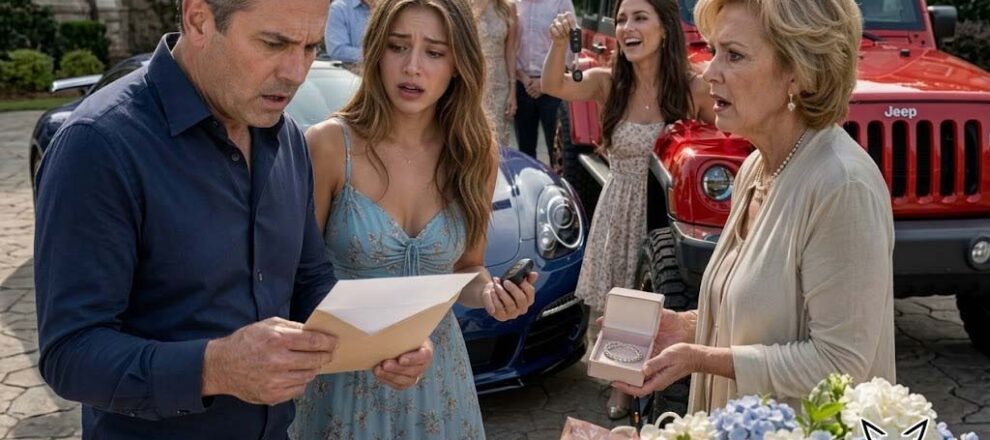
PART 2 — THE MONEY THAT HAD BEEN DISAPPEARING FOR YEARS
The dealership took the Jeep back before dinner.
Not because I ordered them to.
Not because Martin magically froze a vehicle with one phone call.
The title had not been finalized.
The payment was under an active fraud dispute.
And Brianna handed Mark the keys voluntarily.
That last part mattered more than anyone expected.
Mom stood beside the driveway.
“You don’t have to give it back.”
Brianna stared at her.
“It’s Lily’s money.”
“It can be fixed.”
“How?”
“I’ll replace it.”
“With what?”
Mom stopped.
Brianna looked at Denise.
“Mom?”
Denise folded her arms.
“Let’s talk at home.”
“No.”
Her voice shook.
“Did you know?”
Denise looked around at the remaining relatives.
“This is not the place.”
Brianna began crying.
“You let me stand there holding keys to something bought with Lily’s college money.”
“I didn’t know all of it.”
“All of what?”
Denise did not answer.
Brianna turned to Lily.
“I swear I didn’t know.”
Lily looked exhausted.
“I believe you.”
Brianna cried harder.
That was when I realized favoritism does not only hurt the child who receives less.
Sometimes it damages the child receiving more too.
It tells them love is a competition.
And one day, when they realize the trophy came from somebody else’s loss, they have to decide what kind of person they want to become.
Brianna made her first decision that afternoon.
She gave the Jeep back.
Martin came to my house the next morning.
Lily joined us.
I told her she could leave at any time.
She stayed.
“This is my fund.”
Three words.
Firm.
Adult.
I nodded.
“Yes, it is.”
Martin spread documents across the dining table.
My father, Thomas Carter, had started education trusts for both granddaughters twelve years earlier.
Equal initial contributions.
Equal annual additions.
Same investment model.
When Dad died four years ago, each fund had been worth approximately $136,000.
Since then, Brianna’s had legitimately paid for three years of private-school tuition, cheerleading travel connected to school, summer programs, a laptop, and several college visits.
Her remaining balance was about $61,000.
Lily’s fund had barely been touched.
Public school.
Scholarships for summer science programs.
No expensive extracurricular travel.
Its balance before the disputed withdrawals should have been just over $218,000.
“Should have?” I asked.
Martin slid another page toward me.
Current balance:
$141,306.
My throat tightened.
“Where is the rest?”
“We’re tracing approximately seventy-seven thousand dollars in distributions made over the last three years.”
Including the Jeep.
Lily stared.
“Grandma took seventy-seven thousand dollars?”
“We know money left the trust.”
Martin spoke carefully.
“We do not yet know that every distribution was improper.”
“Which ones look wrong?”
He showed us.
$6,800.
College preparatory tutoring.
Lily had never had private tutoring.
$4,200.
Educational travel.
Never happened.
$8,500.
Academic enrichment program.
Nothing.
$3,100.
Laptop and technology reimbursement.
I had bought Lily’s laptop myself.
Then the Jeep.
$54,872.16.
The smaller numbers suddenly mattered more.
The Jeep was loud.
The earlier withdrawals were quiet.
Quiet theft scares me more.
It means somebody expected never to be caught.
“Where did those earlier payments go?”
“Some were reimbursements to Margaret.”
“Mom.”
“Yes.”
“Then?”
“One payment appears to have gone toward a credit card.”
“Whose?”
“Still tracing.”
Another paid a travel company Denise had used.
Another reimbursed an invoice submitted by a tutoring service that no longer existed.
Martin looked at Lily.
“I’m sorry.”
She stared at the table.
“Did Grandpa know Grandma might do this?”
The question hurt.
Martin paused.
“Your grandfather worried about conflict between your father and aunt after he was gone.”
“Why?”
“He loved Margaret.”
He looked at me.
“But he also knew she sometimes confused fairness with making things equal after different choices had already been made.”
I understood.
Mom had said it for years.
Denise needed more help because she was a single mother for a while.
Brianna deserved more because her father was unreliable.
Daniel has a steady job.
Lily has Daniel.
Brianna needs Grandma.
There had always been a reason.
Some true.
Some exaggerated.
Eventually “need” became a permanent permission slip.
Dad knew.
So he inserted the protection clause.
Any family trustee involved in an unauthorized non-beneficiary distribution automatically lost distribution authority until a court or independent fiduciary reviewed the account.
The successor trustee was not me.
Not Denise.
Not Mom.
A trust company.
Dad had planned for the possibility that family loyalty might interfere with financial duty.
I wished he had told me.
Then understood why he hadn’t.
If the protection only worked because Mom forgot it existed, secrecy had value.
Mom called around noon.
I let Lily decide whether she wanted to hear.
She did.
Speakerphone.
Mom began:
“Sweetheart, I need you to understand.”
Lily’s face went cold.
“Don’t call me sweetheart right now.”
Mom stopped.
Good.
“I was trying to make things fair.”
Lily stared at the phone.
“Fair?”
“Brianna’s account is much smaller.”
“Because Aunt Denise used it.”
“On Brianna.”
“Then why take mine?”
Mom sighed.
“You had more.”
“That isn’t an answer.”
Lily sounded so much like my father that I almost smiled.
Mom continued.
“Your father bought you a car.”
“My dad bought me a used car with his money.”
“Exactly.”
“So?”
“You have advantages Brianna does not.”
Lily’s eyes filled.
“Grandma, you gave her a brand-new Jeep.”
“I wanted her to have something special.”
“With my money.”
Silence.
Lily’s voice cracked.
“Then you gave me a fifteen-dollar bracelet and called me scraps.”
“I was joking.”
“No.”
Lily shook her head.
“You always say you’re joking after I get hurt.”
Mom did not answer.
Lily continued.
“You called Brianna the real grandkid.”
“I did not mean literally.”
“What did you mean?”
Nothing.
That was the problem with cruelty disguised as humor.
Ask people to explain the joke and suddenly nobody knows what was funny.
Lily whispered:
“I spent years thinking you liked her more because there was something wrong with me.”
Mom made a small sound.
“Oh, Lily.”
“No.”
My daughter began crying.
“I need you to listen.”
Mom went silent.
“When I was nine, you took Brianna to Disney and told me there wasn’t enough room.”
I remembered.
Denise had described it as a mother-daughter trip.
Mom tagged along.
“When I was twelve, you came to Brianna’s dance competition instead of my science fair.”
Mom said:
“That was scheduling.”
“When I was fourteen, you told me Brianna was the pretty one.”
“I was teasing.”
“When Grandpa died, you gave Brianna his watch because you said she appreciated nice things.”
I froze.
I had not known that bothered Lily.
Dad’s watch.
Not the Mustang story watch—a different one he wore daily.
I looked at her.
She continued.
“And yesterday, you told everyone I get scraps.”
Mom started crying.
“I never wanted you to feel unloved.”
Lily wiped her face.
“Then why was loving me always the thing you did quietly?”
The question broke the room.
Even Mom could not answer it.
After the call ended, Lily sat in silence.
I reached for her.
Then stopped.
“Can I hug you?”
She nodded.
I pulled her close.
“I’m sorry.”
She stiffened.
“For what?”
“For all the times I told you to ignore it.”
“Dad—”
“No.”
I needed to say it.
“I kept thinking protecting you meant helping you not care.”
My voice broke.
“I should have been telling Mom to stop.”
Lily cried into my shoulder.
“I didn’t want you guys to fight.”
That destroyed me.
She had learned exactly what I taught her.
Silence keeps peace.
Pain is cheaper if the quiet person pays it.
“No more.”
I held her tighter.
“You never have to volunteer yourself as the price of family peace again.”
Two days later, the bank’s preliminary accounting found the first major answer.
The $8,500 “academic enrichment” payment had gone to Denise.
Not directly.
Mom reimbursed Denise for an invoice.
The invoice described a college-preparatory summer program for Lily.
Lily had never attended it.
The company named on the invoice belonged to a friend of Denise’s who ran a small event-planning business.
Denise had created the invoice.
I called her.
She answered immediately.
“Daniel.”
“Did you create a fake invoice using my daughter’s name?”
Silence.
“Denise.”
“Mom said she was moving money between the girls.”
“That is not what I asked.”
“She said Dad’s trusts were unfair.”
“They were equal.”
“They stopped being equal because you never used Lily’s.”
“Because Lily didn’t need the money yet.”
“Brianna had needs.”
“So you stole from Lily?”
“Don’t use that word.”
“What word would you prefer?”
Silence.
Then she said:
“I never thought it would hurt Lily.”
I actually laughed.
“You took money from a fund with her name on it.”
“Mom said she would replace it.”
“With what?”
“She always has money.”
Not seventy-seven thousand dollars of spare money.
Maybe Denise had never checked.
Maybe she had not wanted to.
Then I asked:
“Who signed my name on the Jeep distribution?”
The line went completely quiet.
I knew.
“Denise.”
Her voice became tiny.
“Mom said you had already agreed.”
My stomach turned.
“What did you do?”
“She had an old trust form with your signature.”
I closed my eyes.
“You copied it.”
“I traced it.”
There it was.
Not sophisticated identity theft.
Not hackers.
A sister at her mother’s kitchen table tracing my signature because both of them had decided my permission was a technicality.
“Why?”
Denise began crying.
“Because Mom said the bank needed it before Brianna’s birthday.”
“You knew I had not signed.”
“Yes.”
“You knew Lily’s name was on the trust.”
“Yes.”
“You knew the Jeep was for Brianna.”
“Yes.”
Every yes felt worse.
I whispered:
“Then stop telling yourself you didn’t know.”
She cried.
I hung up.
My hands shook for almost an hour.
PART 3 — THE CHILD WHO GOT EVERYTHING WAS HURTING TOO
Brianna came to our house alone that Friday.
She carried the cheap bracelet.
I frowned.
“Why do you have that?”
“Lily left it on Grandma’s table.”
Lily came downstairs.
Brianna held it out.
“I thought you might want it.”
Lily stared.
“No.”
Brianna nodded.
Then put it on the coffee table.
Neither girl spoke.
They had grown up six months apart.
Almost sisters when they were little.
Matching pajamas.
Sleepovers.
Birthday cakes.
Then somewhere around middle school, Mom began comparing them.
Brianna is outgoing.
Why can’t you be more like Brianna?
Lily is too serious.
Brianna knows how to have fun.
Brianna has a boyfriend.
Lily needs to come out of her shell.
When adults compare children often enough, eventually children start doing the work themselves.
Brianna sat.
“I didn’t know about the Jeep.”
Lily nodded.
“I know.”
“I knew Grandma liked buying me stuff.”
Another pause.
“I liked it.”
Lily looked at her.
“You’re allowed to like gifts.”
“That’s not what I mean.”
Brianna started crying.
“I liked being the favorite.”
The honesty surprised both of us.
She continued.
“When we were kids, I thought Grandma liked me more because I was better.”
Lily’s face changed.
“Bri.”
“No.”
She wiped her nose.
“I need to say it.”
She looked at Lily.
“I thought if I got better grades, dressed right, laughed at her jokes, went shopping with her, she would keep choosing me.”
Lily whispered:
“She already chose you.”
“That’s what you saw.”
Brianna shook her head.
“What I saw was that every time you did something good, Grandma found something bigger I had to do.”
Lily stared.
“When you won that science award, she made me enter the county dance competition.”
“When you got your first job, she told me I needed a better one.”
“When you started volunteering at the hospital, she spent two months asking what my college résumé had on it.”
Brianna cried.
“I kept thinking if you became better than me, she might switch.”
The room went completely quiet.
Favoritism had taught one girl she was worthless.
And the other that love could be revoked.
Same poison.
Different symptoms.
Lily sat beside her.
“I hated you sometimes.”
Brianna nodded.
“I know.”
“I thought you liked it when Grandma hurt me.”
“Sometimes I did.”
That hurt.
Brianna did not run from it.
“When we were younger.”
She cried harder.
“Because if she was making you small, I felt safe.”
Lily looked away.
I wanted to interrupt.
Protect.
Smooth.
Instead I stayed quiet.
This belonged to them.
Brianna continued.
“I’m sorry.”
Lily’s face crumpled.
“I’m sorry too.”
“For what?”
“For thinking everything was your fault.”
They both cried.
Then Lily said:
“I don’t want Grandma’s crap to be the reason we don’t know each other when we’re thirty.”
Brianna laughed through tears.
“Me neither.”
It was not instant forgiveness.
It was better.
A decision to stop inheriting a competition neither of them created.
The independent trustee completed a broader review over the next month.
The total unauthorized or unsupported withdrawals from Lily’s trust were $76,972.16.
The Jeep represented most of it.
The dealership unwound the conditional sale.
Trust funds were returned minus a small administrative cost the dealership ultimately waived after the investigation.
That recovered $54,872.16.
The remaining disputed amount was approximately $22,100.
Some had gone to Denise.
Some to Mom.
A few payments remained ambiguous but unsupported.
Martin filed a petition asking the probate court overseeing the trust to approve the successor trustee, compel a full accounting, and surcharge Mom for improper distributions.
No one was dragged from a courtroom.
No judge shouted.
Real financial consequences came through motions, bank records, hearings, negotiations, and very expensive attorneys.
The police also opened an investigation after I reported the forged signature.
I hated doing it.
Let me be clear about that.
Denise was my sister.
Mom was my mother.
For three days, I told myself maybe civil court was enough.
Then Lily asked:
“If Brianna’s mom had forged your signature to take money from somebody else, would you report it?”
I knew the answer.
“Yes.”
She nodded.
“Then don’t change the rule because it was mine.”
My eighteen-year-old daughter had more clarity than I did.
I made the report.
Mom came to my house the next evening.
I did not let her walk in.
That was new.
She stood on the porch.
“Are you really doing this?”
“Doing what?”
“Police.”
“Someone forged my signature.”
“Your sister made a mistake.”
“A mistake is signing on the wrong line.”
“She was trying to help.”
“No.”
Mom flinched.
I continued.
“She was trying to get what you wanted.”
“You think I wanted to hurt Lily?”
“I think you decided hurting Lily was acceptable because you liked the reason.”
Her face reddened.
“I was trying to balance what your father did.”
“What Dad did?”
“He left those girls with equal trusts.”
“Yes.”
“That wasn’t equal.”
I stared.
“What?”
“Brianna had one parent for years.”
“Denise received child support.”
“Barely.”
“You helped her.”
“Because she needed it.”
“Okay.”
“You had a good job.”
“Yes.”
“Lily had you.”
I finally understood.
In Mom’s mind, Dad’s equal trusts were unfair because our lives were not equally difficult.
“So because Lily had a stable father, she deserved less from Grandpa?”
“That’s not what I said.”
“It’s exactly what you said.”
Mom cried.
“Denise struggled.”
“I know.”
“Brianna watched other kids have things she couldn’t.”
“I know.”
“So when I could give her something—”
“You gave her everything.”
Mom stopped.
I continued.
“And you made Lily watch.”
“I did not.”
“The Jeep?”
She looked away.
“The bracelet?”
“It was a joke.”
“The Disney trip?”
“The dance competitions?”
“The comments about looks?”
Mom started shaking her head.
“You are making me sound horrible.”
“I’m describing things you did.”
That sentence hurt her more than anything.
She sat on the porch step.
For the first time in my life, my mother looked old.
“I thought Lily was strong.”
I almost laughed.
“She was a child.”
“She had you.”
“That did not make her immune to you.”
Mom covered her face.
“I thought Brianna needed me more.”
Maybe that was true.
But I finally understood the deeper problem.
“You didn’t just help the child who needed more.”
Mom looked up.
“You made sure everybody knew which child you were helping.”
Silence.
“There’s a difference.”
She cried.
“I don’t know how to fix this.”
I believed her.
For once, there was no check large enough.
No Jeep.
No gift.
No joke.
No family dinner where everyone pretended.
“You start by not asking Lily to make you feel better.”
Mom nodded.
“Can I see her?”
“Not today.”
Her face fell.
“Does she hate me?”
“I don’t know.”
“You’re her father.”
“That doesn’t mean I answer for her.”
I had learned something too.
Mom left.
No hug.
I watched her walk toward her car.
Part of me wanted to call her back.
The child inside me still believed a son should never send his mother away crying.
Then I thought about all the times Lily had cried quietly so the adults could remain comfortable.
I closed the door.
Two weeks later, Denise’s attorney contacted mine.
She wanted to cooperate.
She admitted tracing my signature.
She admitted preparing the false enrichment invoice.
She said Mom had directed both.
But then she added something Martin did not expect.
The first questionable withdrawal had not been Mom’s idea.
It was Denise’s.
Three years earlier, Brianna had been invited to an expensive summer dance program.
Denise could not afford it.
She asked Mom for money.
Mom said Brianna’s trust was already covering private-school tuition and she did not want to reduce it further.
Denise said:
“Lily has almost two hundred thousand sitting there.”
Mom initially refused.
Then Denise argued Dad would have wanted both girls to have opportunities.
Mom reimbursed the $8,500 using Lily’s trust.
Once.
Then another time.
Then another.
Small lines moved.
Morality adjusted.
By the time the Jeep came around, they were no longer asking whether using Lily’s money was wrong.
They were only asking how to get the form approved.
That scared me more than a master plan would have.
Most families are not destroyed by one giant evil decision.
They are destroyed by smaller decisions that become normal.
PART 4 — THE APOLOGY MY DAUGHTER DIDN’T OWE ANYONE
The court removed Mom as trustee.
Technically, Dad’s trust clause had already suspended her authority after the disputed distribution.
The court confirmed it.
The independent trust company took permanent administrative control.
I remained Lily’s parent representative only for the few months until she turned fully responsible for certain beneficiary decisions under the trust terms.
Even then, she could not simply withdraw everything.
Dad had designed staged access.
Education first.
Broader discretionary access later.
Smart man.
Annoying man.
I missed him.
The settlement required Mom to restore the unsupported amounts that were not recovered from the Jeep transaction.
Denise was responsible for the portions she had received or fabricated.
They also covered a significant share of professional fees caused by the misconduct.
Mom sold a collection of jewelry.
Denise took out a home-equity loan.
Nobody became homeless.
Nobody was reduced to eating beans under a bridge.
They simply had to pay back money that had never been theirs.
That was consequence enough.
The criminal side moved separately.
Denise ultimately entered a plea involving forgery and falsification-related conduct.
Because she cooperated, had no prior record, and restitution was made, her sentence involved probation, community service, financial restrictions, and a suspended jail term.
Mom entered a separate plea involving misuse of entrusted funds and her role in the false authorization.
Age did not erase responsibility.
Neither did being Grandma.
She received probation, court supervision, restitution obligations, and a prohibition against acting in any fiduciary role for family trusts.
Some relatives called the outcome too harsh.
Others called it too soft.
I stopped caring.
Punishment was not my job.
Truth was.
The emotional consequence was harder.
Lily did not see Mom for eight months.
Mom sent birthday cards.
Lily did not answer.
Christmas gifts arrived.
Lily returned them unopened.
Mom called me.
I refused to carry messages.
“You have her number.”
“She blocked me.”
“Then you have your answer for now.”
“But I’m her grandmother.”
“I know.”
“Doesn’t that mean anything?”
“Yes.”
I paused.
“That’s why it hurts.”
Mom cried.
I still did not fix it.
Progress.
During those months, Lily started college.
University of Cincinnati.
Nursing.
She chose a dorm even though home was close enough for commuting.
“I need to do something by myself.”
I understood.
The trust paid tuition, housing, books, and a reasonable living allowance under independent administration.
Her academic scholarship covered part.
She kept the Mustang.
And yes, before anyone asks, she took the advanced driving course.
She also paid part of the increased insurance from her weekend job because she insisted.
“I’m not letting Grandpa’s education money pay Mustang insurance.”
Dad would have laughed.
Move-in day almost broke me.
We carried boxes up three flights because the elevator line was ridiculous.
Lily had labeled everything.
BED
DESK
BATHROOM
DO NOT LET DAD TOUCH
I touched that one immediately.
She yelled.
For an hour, we were normal.
Then I found an envelope at the bottom of a box.
Martin had given it to Lily that morning.
Dad’s handwriting.
My father.
Her grandfather.
The trust contained one final personal letter to be delivered when Lily began college.
She sat on the bed.
“Read it with me?”
“Are you sure?”
“Yes.”
She opened it.
Lilypad,
Only Dad called her that.
Lily started crying immediately.
If you are reading this, you made it to whatever comes next.
Maybe college. Maybe trade school. Maybe something none of us expected.
If Daniel is crying already, tell him I said he is embarrassing himself.
I laughed while crying.
Lily did too.
She continued.
I put money aside because education gives you choices.
But money is not love.
Never let anyone convince you the size of a gift proves the size of a heart.
We both went still.
Grandpa could not have known about the bracelet.
But somehow it felt like he did.
Your grandmother and I sometimes disagree about what fairness means.
My breathing changed.
She sees the person who needs help today. I sometimes worry about the person who stays quiet because they do not want to become another problem.
Lily looked at me.
My eyes filled.
If that quiet person is ever you, speak.
Needing less attention does not mean deserving less care.
Lily covered her mouth.
I could barely see the page anymore.
Then:
And if your father ever tells you to ignore something hurtful just to keep the peace, remind him that peace purchased with one person’s silence is not peace.
Lily slowly turned toward me.
I shook my head.
“That old man planned to haunt me specifically.”
She laughed through tears.
Then kept reading.
I love Brianna too.
Do not let the adults turn the two of you into opponents.
That broke her.
She sobbed.
I held her.
Dad had seen it.
Before the Jeep.
Before the forged signature.
Before everything.
The comparisons.
The imbalance.
The danger.
Not enough to stop it.
Enough to leave a warning.
The letter ended:
Spend wisely. Learn something useful. Make at least one terrible decision that teaches you more than a good decision would.
Call your father.
And remember: you do not have to earn your place in a family that truly loves you.
Grandpa
Lily pressed the letter against her chest.
Then whispered:
“I wish Grandma believed that.”
I did too.
Brianna visited the following weekend.
She was starting college locally.
Not because the Jeep disappeared.
That had always been her plan.
She brought Lily a gift.
A bracelet.
I looked at it suspiciously.
Brianna laughed.
“It cost twelve dollars.”
Lily laughed so hard she cried.
It was a simple braided blue-and-red bracelet.
Their school colors.
Brianna tied it around Lily’s wrist.
“No scraps speech.”
“Thank you.”
Then Brianna became serious.
“Grandma wants me to ask you to talk to her.”
Lily’s face changed.
Brianna immediately held up both hands.
“I told her no.”
Lily relaxed.
“She cried.”
“I’m sure.”
“I felt bad.”
“That’s okay.”
Brianna nodded.
“I’m trying not to make feeling bad mean I have to do what she wants.”
Lily looked at me.
I looked away theatrically.
Apparently everybody was learning.
Mom finally saw Lily eight months later.
Not because I arranged it.
Not because Brianna pressured her.
Lily called.
She chose a coffee shop.
Public.
One hour.
She asked me to sit at another table.
I did.
I could hear almost nothing.
Later, Lily told me the important parts.
Mom apologized.
Not:
I’m sorry you misunderstood.
Not:
I’m sorry, but Brianna needed me.
A real apology.
“I humiliated you because making Brianna feel special had become more important to me than noticing what I was doing to you.”
Lily asked:
“Why?”
Mom said:
“Because I liked being needed.”
That surprised me.
Mom had spent years believing Denise and Brianna needed her more.
Need gave her a role.
A purpose.
A way to be central.
Lily asked:
“Did you love her more?”
Mom cried.
“No.”
“Then why did it feel like you did?”
Mom apparently took a long time to answer.
Finally:
“Because I acted like I did.”
That was honest.
Lily did not forgive her immediately.
Instead she said:
“I don’t want to be the real grandkid.”
Mom looked confused.
Lily continued.
“I don’t want Brianna to be the fake one either.”
Then:
“I just want you to stop ranking us.”
Mom cried.
Lily let her.
At the end, Mom asked:
“Can I hug you?”
Lily said:
“Not yet.”
Mom answered:
“Okay.”
When Lily told me that, I knew something had changed.
Not because Mom apologized.
Because she finally heard no without trying to negotiate it.
PART 5 — WHAT “REAL FAMILY” FINALLY CAME TO MEAN
Three years passed.
Not every wound disappeared.
That matters.
Families do not survive betrayal by returning to exactly what they were.
Sometimes surviving means becoming something different.
Denise and I were never as close again.
For the first year, we spoke only about practical things.
Then Brianna’s college graduation approached.
Denise called.
“I want you there.”
“Does Brianna?”
“Yes.”
That was the only answer that mattered.
I went.
Lily came too.
When Brianna walked across the stage, Lily stood and screamed louder than anyone.
Mom cried beside me.
She did not say:
That’s my real grandkid.
She simply said:
“I’m proud of her.”
Progress can sound very ordinary.
Denise apologized to Lily directly two years after the Jeep.
It took her too long.
But when she finally did, she did not blame Mom.
“I traced your dad’s signature.”
Lily already knew.
“I told myself Grandma had the right to move the money.”
Denise cried.
“I knew she didn’t.”
No excuse.
Then:
“I let myself believe you had enough because that made taking from you easier.”
Lily listened.
Denise continued.
“I’m sorry.”
Lily asked:
“Why didn’t you think about me?”
The question shattered my sister.
Because there was no sophisticated answer.
“I was thinking about Brianna.”
Lily nodded.
“That’s what everybody says.”
Denise cried harder.
Lily did not comfort her.
Good.
Then she said:
“I hope you never do that to somebody again.”
“I won’t.”
“I hope not.”
That was the entire conversation.
They never became aunt and niece who called every Sunday.
But they could share a room without pretending.
Sometimes repair means honesty with distance.
Mom’s relationship with Lily returned slower.
Cards first.
Then coffee.
Then occasional lunches.
No expensive presents.
Lily made that rule herself.
On her nineteenth birthday, Mom gave her a used hardcover copy of a nursing memoir.
Inside she wrote:
I saw this and thought of you. No comparisons. No price tags. Love, Grandma.
Lily kept it.
On her twentieth birthday, Mom baked Dad’s terrible chocolate cake recipe.
It collapsed in the middle.
Lily laughed.
On her twenty-first, Mom asked:
“What would you like?”
Lily answered:
“Dinner.”
That was all.
They went to a diner.
Mom paid thirty-eight dollars.
Lily told me it was the best gift she had ever received from her.
Not because dinner was better than a Jeep.
Because nobody lost anything for her to receive it.
Brianna changed too.
The red Jeep became a family joke eventually.
Not immediately.
Years later.
She bought her own first car after college.
A used Honda CR-V.
She sent Lily a picture.
PAID WITH MY MONEY. PLEASE ALERT GRANDMA.
Lily nearly fell off the couch laughing.
Brianna had gone into speech-language pathology.
She later told me the whole trust disaster shaped how she thought about families and children.
“Adults tell themselves kids don’t notice rankings.”
She looked toward Lily.
“We noticed.”
Yes.
They always do.
Lily graduated from the University of Cincinnati four years after the birthday.
Nursing degree.
Honors.
The night before graduation, I found her sitting on the hood of the blue Mustang in our driveway.
Same car.
More scratches.
One dent she still claimed appeared “mysteriously.”
I sat beside her.
“Thinking?”
“Dangerous, I know.”
“What about?”
“Grandpa.”
“Yeah.”
“He’d be annoying tomorrow.”
“Absolutely.”
“He’d wear that ugly tie.”
“The green one.”
“And tell everyone he paid for college.”
“He would.”
She smiled.
Then became quiet.
“Dad?”
“Yeah?”
“Do you remember the bracelet?”
Unfortunately.
“Grandma’s?”
“Yes.”
“What about it?”
“I still have it.”
That surprised me.
“Why?”
She looked toward the house.
“For a long time I kept it because I was angry.”
I nodded.
“Then I thought about throwing it away.”
“Why didn’t you?”
She shrugged.
“Because it’s just a bracelet.”
That took me a second.
She continued.
“It didn’t make me scraps.”
I felt tears coming.
“The Jeep didn’t make Brianna more important.”
She looked at me.
“It was adults putting meaning on things.”
I swallowed.
“Yes.”
“So I stopped letting the bracelet be evidence.”
I stared at my daughter.
When did she become wiser than me?
Probably years earlier.
She reached into her pocket.
The cheap heart bracelet lay in her palm.
“I’m wearing it tomorrow.”
I blinked.
“Seriously?”
“With Grandpa’s letter in my bag.”
“Why?”
She smiled.
“Because Grandma doesn’t get to decide what the bracelet means anymore.”
I laughed through tears.
“That is extremely dramatic.”
“I’m your daughter.”
Fair.
Graduation morning, Lily walked across the stage wearing her cap and gown.
The tiny fifteen-dollar heart bracelet hung from her wrist.
Mom saw it.
Her face crumpled.
She did not make the moment about herself.
She simply clapped.
Brianna screamed.
Denise cried.
I embarrassed everybody.
As required by law.
Afterward we took pictures.
One with me and Lily.
One with Brianna.
One with Mom.
Then Lily surprised us.
“Everybody.”
Denise hesitated.
Mom did too.
Lily waved them closer.
“One picture.”
We stood together.
Not healed perfectly.
Not pretending.
Just people who had made terrible decisions, survived consequences, changed in uneven ways, and learned that forgiveness and access were different things.
The camera clicked.
Martin found me afterward.
He had retired six months earlier.
“You look old,” I told him.
“You’re welcome for keeping your family out of federal prison.”
“That is not exactly what happened.”
“Retirement lets me improve stories.”
He handed me an envelope.
I groaned.
“No more trust documents.”
“Not a trust document.”
Dad’s handwriting.
Again.
“You’re kidding.”
“Thomas left several letters.”
“To whom?”
“This one is yours.”
I opened it later that night.
Alone.
Daniel,
If you are reading this, Lily is probably grown and I am probably dead, which means I finally won an argument by becoming impossible to interrupt.
I laughed.
Then:
You are a good father.
I stopped.
Four words.
My eyes filled.
That does not mean you will always be right.
There he was.
Your weakness is the same one I had when you were young.
You hate conflict with people you love.
I swallowed.
Be careful.
Avoiding a fight can feel like kindness when the person paying for the peace is not you.
Tears blurred the page.
If Margaret and Denise ever make Lily feel smaller to keep themselves comfortable, do not ask Lily to be the bigger person.
I covered my face.
He knew.
Not what would happen.
Who we were.
Children who are called mature too early often become adults who apologize for having needs.
That line destroyed me.
For years, I had been proud of how mature Lily was.
How she never demanded things.
How she shrugged off Grandma’s comments.
How she understood.
Some of that was character.
Some was adaptation.
Dad continued.
Your job is not to make Lily easy for the family to love.
Your job is to make sure she knows love should not require her to disappear.
I cried for a long time.
Then reached the final paragraph.
One last thing.
Do not confuse money with justice.
If these trusts ever cause a fight, remember why I made them.
I did not put money aside so the girls could have better cars.
I put it aside so they would have choices when I was no longer around to help.
Protect the choices.
The numbers will take care of themselves.
Dad
I folded the letter.
Sat alone in the kitchen.
And finally understood why the story had never really been about the Jeep.
Two years later, Lily worked nights at a hospital in Cincinnati.
Just like she once dreamed.
The trust still had money left.
She could have used it to upgrade the Mustang.
She didn’t.
She could have bought a condo.
Not yet.
She used part of the remaining education allowance for graduate school.
The rest stayed invested.
One Thursday night, she called me at 2:13 a.m.
I answered half asleep.
“Everything okay?”
“Yes.”
“Then why are you calling at two in the morning?”
“I had a patient.”
“That narrows it down.”
She laughed.
“Sixteen-year-old girl.”
“Okay.”
“Her grandmother kept answering every question for her.”
I became fully awake.
“What happened?”
“I asked the grandmother to give us a minute.”
I smiled.
“Then?”
“The girl told me what was actually wrong.”
Lily became quiet.
“Dad?”
“Yeah?”
“I think Grandpa would’ve liked that.”
My throat tightened.
“I think so too.”
After we hung up, I walked into my office.
Dad’s letter was framed there.
Not the entire thing.
Just one line.
PROTECT THE CHOICES.
Beneath it sat a photograph from Lily’s eighteenth birthday.
Not the moment with the Jeep.
Not the Mustang.
A picture taken later that evening after most relatives left.
Lily and Brianna sitting on the hood of the blue Mustang.
Both barefoot.
Both laughing.
The cheap bracelet still around Lily’s wrist.
The red Jeep already gone.
For years, my mother believed a “real gift” needed to be bigger.
More expensive.
More impressive.
She had almost destroyed two granddaughters trying to prove it.
Dad understood something she did not.
Money can pay tuition.
Buy cars.
Open doors.
Solve emergencies.
It can even become a weapon when the wrong person decides someone else deserves it more.
But money cannot tell a child where she ranks in a family.
Adults do that.
With their words.
Their attention.
Their comparisons.
Their silence.
I could not undo every time Lily had been made to feel second.
I could not erase the birthday when her grandmother called her scraps.
I could not make the forged signature disappear from our family history.
But I could make sure we stopped lying about what happened.
Mom had stolen from Lily.
Denise had helped.
I had stayed quiet too many times before that.
Brianna had benefited from favoritism she did not create.
Every one of those things was true.
So were other things.
Mom eventually took responsibility.
Denise repaid what she owed.
Brianna rejected the competition.
Lily refused to let humiliation define her.
And I finally learned that protecting my daughter did not mean teaching her how to survive disrespect gracefully.
Sometimes protection means making the room uncomfortable.
Sometimes it means filing the report.
Sometimes it means closing the door on your own mother.
Sometimes it means asking your daughter what she wants before deciding for her.
And sometimes it means standing beside her while she wears a fifteen-dollar bracelet to graduation because she has decided nobody else gets to tell her what it means.
My mother once called Lily scraps.
She was wrong.
Lily was never what remained after somebody else got the best.
She was never second.
Never less.
Never the quiet child who should accept whatever was left.
And the trust my father created did more than protect her college money.
It forced our entire family to confront something we should have understood long before there was a Jeep in the driveway.
Love is not measured by who receives the biggest gift.
It is measured by whether the people who claim to love you still respect what belongs to you when they want it for someone else.
That was the inheritance Dad really protected.
Not the money.
The choice.
And by the time Lily understood that, nobody in our family would ever be able to call her scraps again.