
PART 1:
Nobody in the building thought he belonged there.
Not the receptionist who glanced at his worn jacket and looked away.
Not the junior associates who whispered behind their coffee cups, not even the security guard who made him sign in twice.
As if the first time hadn’t counted, the man standing in the lobby of Carter Capital group on that gray Tuesday morning was quiet, unhurried, and completely unmoved by every silent signal telling him he was in the wrong place.
His name was Daniel Brooks.
He was 41 years old, recently divorced, working three different jobs to keep his daughter in a decent school across town, and he had answered a job listing for a private driver position, with the same calm efficiency he brought to everything else in his life.
He filled out the form.
He submitted it.
He showed up exactly eight minutes early.
Evelyn Carter had built Carter Capital from nothing from a two bedroom apartment in Cincinnati, where she had slept on an air mattress for two years, while cold calling investors who hung up on her to a midtown man-hatten tower, with her name engraved above the 40th floor entrance in brushed steel letters.
She was 38 years old, worth somewhere north of $1.4 billion depending on the quarter, and she had not taken a vacation in six years.
Her assistance came and went so quickly that the HR department had developed a standardized off-boarding checklist, specifically for people who worked directly under Evelyn Carter.
She was not cruel.
She was exacting.
There is a difference, though few people in her orbit seemed to appreciate it.
What Evelyn demanded was precision, discretion, and loyalty, and what she kept discovering.
Again and again, was that those three things were far rare than money.
The last driver had sold her schedule to a rival fund.
The one before him had been photographed outside a private medical appointment by a photographer, who had clearly been tipped off by someone on the inside.
The bodyguard before that had been quietly terminated after it emerged, he was feeding information to a tabloid journalist.
Evelyn had stopped being surprised by betrayal.
She had simply begun treating it as a baseline condition of her life.
The way other people treated traffic or bad weather and inconvenience to be managed, not a wound to be mourned.
When her chief of staff, a meticulous woman named Patricia placed Daniel Brooks’s application on her desk alongside seven other candidates.
Evelyn looked at it for exactly 40 seconds before setting it aside.
She was not impressed, but something made her look at it again.
His military file was sealed.
Not redacted sealed.
There was a difference.
Redacted files still showed the shape of what had been removed.
Sealed files showed nothing at all.
As if the years in question had never existed.
Under employment history, he had listed security consulting, logistics coordination, and private transport.
Under references, he had listed two names.
A retired marine colonel and a former federal judge, both references were brief, factual, and strangely formal, as if they had been written by men who chose every word with surgical care.
Patricia had called both of them.
The colonel had said, Daniel Brooks is the most capable man I have ever personally witnessed under pressure.
I would trust him with my life.
I have.
The judge had said simply, higher him, neither had elaborated, neither had needed to.
Evelyn looked at the application a third time, then told Patricia to bring him in.
He did not try to impress her.
That was the first thing she noticed.
Every other candidate had leaned forward in their chairs, had adjusted their posture, had launched into practice speeches about loyalty and professionalism, and how much they admired what she had built.
Daniel sat with his back straight, his hands folded loosely on the table, and answered her questions in short, direct sentences.
When she asked him why he had left the military, he said, it was time.
When she asked what he could offer that other candidates could not, he was quiet for a moment.
And then he said, I noticed things.
She waited for him to explain.
He didn’t.
She hired him the next morning.
The staff reaction was immediate and unanimous.
Marcus in corporate security sent Patricia an email with three question marks in the subject line, and nothing in the body.
The executive assistant pool spent a lunch hour collectively agreeing that Evelyn had lost her edge.
One of the senior analysts, a man named Gregory, who had worked at the firm for 11 years, and believed this gave him special interpretive authority over all of Evelyn’s decisions, told anyone who had listened that she had clearly hired someone with no relevant qualifications for a role that required the highest level of vetting.
He used the word liability four times in one conversation.
Nobody told Daniel any of this, and it would not have mattered to him if they had.
His first day began at 645 in the morning.
He arrived at the parking structure 40 minutes before Evelyn’s scheduled departure.
Walk the entire route from the building side exit to the primary vehicle.
Check the cars under carriage, inspected the tire pressure, and made note of every camera angle along the first eight blocks of the usual morning route.
He did all of this without being asked, and without telling anyone he had done it.
When Evelyn arrived at the car precisely on time, he opened the door, waited for her to settle, and pulled smoothly into traffic without a word.
It was not until they had cleared the third intersection that he glanced once in the rear view mirror, and held the reflection of a black sedan two cars back for exactly three seconds.
He said nothing.
He adjusted the route by two blocks, exit it onto a side street, re-entered the main avenue from a different angle, and watched the sedan fail to reappear.
His expression did not change.
Evelyn noticed.
She noticed because she noticed everything too.
Though she had learned to hide it.
She said nothing, but she watched him in the mirror for the rest of the drive, and she thought about the Colonel’s words.
The most capable man I have ever personally witnessed under pressure.
She had assumed it was the kind of hyperbole men used about other men they admired.
Now she was less certain.
The second week was when the friction started.
Daniel had begun varying the routes, not randomly.
But according to a pattern, she could not immediately decode.
He would take the long way to avoid a particular block, or depart 15 minutes earlier than scheduled without prior notice, or request that she delay a lobby exit by 90 seconds.
For reasons he described only as a better moment.
Evelyn Carter had not built a billion dollar enterprise by tolerating ambiguity from people in her employee.
She told him, on a Wednesday afternoon as they sat in traffic on the bridge, that she expected to be informed of any changes to her schedule before they happened, not as they were happening.
He looked at her in the mirror.
He said, understood, he did not change his behavior.
He simply began telling her 30 seconds in advance instead of simultaneously.
She found this infuriating, and in some deeply inconvenient part of herself, slightly reassuring.
PART 2:
The incident at the Whitmore dinner changed things, it was a quarterly event, 40 of the city’s most influential financial figures in a private dining room at a hotel that charged more per night than most people earned in a month, Evelyn attended every year.
She did not enjoy it, but she understood the mathematics of visibility.
Daniel drove her, parked in the hotel’s underground structure, and was supposed to wait.
He did not wait.
He positioned himself near the service entrance of the dining level, and spent the evening doing what he always did, watching.
He saw the man at the far table near the kitchen corridor, 12 minutes before anything happened.
The man was dressed correctly, and had a name tag like everyone else.
But he had not touched his food, and he kept his left hand below the table in a way that was not relaxed.
It was deliberate.
Daniel moved through the room without drawing attention.
Reach Devlin, in the middle of a conversation about emerging market volatility, touched her elbow once, and said quietly.
We’re leaving.
She started to object.
He said, now, something in his voice reached past her objection, and landed somewhere older and more instinctive.
She excused herself, they walked to the corridor, and they were in the elevator when the dining room behind them erupted in shouting, and the sound of something heavy hitting the floor, they did not go back.
Later, the hotel would confirm that a man with a concealed weapon had been detained by hotel security, after behaving erratically near the main dining room.
Evelyn read the report in her car on the way home.
She looked at Daniel’s reflection in the mirror for a long time and said nothing.
She hired an investigator the following morning.
She told herself, it was due diligence, she had a right to know who was driving her.
And she had a right to know why his file was sealed.
The investigator was thorough and expensive, and returned.
After five days, with almost nothing.
A name, a date of birth, an honorable discharge.
Two addresses, both years out of date.
Three photographs from a unit portrait that showed a younger Daniel standing at the edge of a group of men in desert gear, his face partially turned away from the camera, as though the photographer’s presence had registered as a potential threat, rather than an occasion.
The investigators report ended with a single sentence that Evelyn read twice.
This individual has been professionally obscured.
The absence of information is itself information.
She sat with that for a long time.
She had grown up in a world where obscurity meant shame.
Where people hid things, because those things were bad, but she had also spent nearly two decades in finance.
And she had learned that the most powerful information in any room was usually the information that wasn’t in the room.
The things that didn’t appear in filings, the meetings that weren’t on calendars, the decisions that had no paper trail, Daniel’s silence was not the silence of someone hiding a crime.
It was the silence of someone who had operated at a level where even the record of the operation was classified.
She understood that distinction.
It did not make her less cautious.
It made her more curious.
Daniel meanwhile, was remembering things he had spent three years trying to stop remembering.
The job had a way of doing that the daily ritual of protection, the constant scanning.
The way his body moved through a threat assessment without his conscious mind needing to participate.
He had trained for so long that the training had become architecture.
It was inside the walls, not on the surface.
He had hoped that driving a wealthy executive through Manhattan would be mundane enough to keep the architecture quiet.
It was not, because someone was watching Evelyn Carter with professional intent, and the more time Daniel spent in her orbit, the more clearly he could see the shape of it.
He had been 19 years old when he first qualified for special operations consideration.
22, when he was selected for seal training, and 24, when he completed his first classified deployment in a country whose name he had never been permitted to say aloud in any official context.
For 11 years after that, he had existed in the space between official records.
A man whose work was real, but whose footprint was engineered to be invisible.
He had gone into places that could not be acknowledged.
Extracted people whose survival was politically inconvenient to explain, and done things that were necessary, in ways that the people who authorized them prefer to understand only in the abstract.
He had been good at it, remarkably, uncomfortably good at it.
He had also lost on a mountainside outside a small city that appeared on no military map he had ever been officially issued.
The person he trusted most in the world a man named Holt, his team lead, his closest friend, who had died because of a decision that Daniel had made, and had spent every subsequent year turning over in his mind, like a stone with something wrong underneath it.
He had left the military six months after Holt’s death.
He had moved to a small apartment in New Jersey, taken every job he could find, and tried to become someone whose past was simply the past.
It had worked reasonably well for a while.
Until now, the threat against Evelyn was not random.
Daniel understood this the way he understood everything through pattern, through repetition, through the particular quality of attention that certain kinds of danger demanded.
He had been tracking the surveillance on her schedule for three weeks before he had enough to bring to her, and when he finally did, he laid it out carefully.
The black sedan that had appeared six times in seven days, always at a distance that suggested professional discipline rather than amateur interest.
The anomaly in her corporate email system that her IT department had flagged, and then strangely, unflagged without resolution.
The fact that her parking structure access log showed a vehicle entering and exiting at three in the morning, on a night when the structure was supposed to be closed for maintenance, he placed the information in front of her without drama, without urgency theater, without the kind of performative alarm that would have made it easy for her to dismiss him as excitable.
He simply showed her the pattern and let her look at it.
She was quiet for a long time.
Then she said, who do you think is behind it?
He said, someone who wants what you’re building the hargrove merger to become, and doesn’t want you to complete it.
The hargrove merger was the largest acquisition she had ever pursued a deal that would consolidate three mid-sized technology infrastructure companies under Carter Capital Zumbrella and reshape the firm’s market, position entirely.
It was also as Daniel had begun to understand the kind of deal that made powerful people frightened.
Frightened people made mistakes.
They also, sometimes, made decisions.
The sabotage began the following week.
Her primary vehicle had a break line that had been partially severed not enough to cause immediate failure.
But enough that a hard stop at highway speed would have been catastrophic.
Daniel founded during his morning inspection and said nothing to Evelyn until after he had replaced the car entirely with a secondary vehicle from the firm’s pool.
Then he told her, quietly, and without visible emotion, what he had found.
She looked at the photograph he had taken of the break line and she felt, for the first time in many years, genuinely afraid.
Not the abstract, managed fear of financial risk or competitive threat but the older, more physical fear of a world that was trying to do something irreversible to her.
That same afternoon, her secure email system was compromised.
The following morning, two members of her security team reported that the firm’s secondary office on the east side had been entered overnight, with files and server drives physically disturbed.
Evelyn called Daniel into her office, closed the door, and said, tell me what you think we should do.
He told her.
She listened.
It was the first time in her professional life that she had listened to someone else’s security assessment without immediately redirecting it.
The Ashford resort was 140 miles north of the city.
In a mountain range that became genuinely remote in the last 20 miles of the approach, Evelyn had a contract to sign the final phase of the Hargrove deal, requiring her physical presence and wet signature on documents that her lawyers had insisted could not be completed remotely.
Daniel had asked her to delay.
She had explained, with careful precision, that the legal window for the signature was 72 hours, that the window closed at noon on Friday, and that it was currently Wednesday morning.
He had said, I understand.
He had packed the car with items that were not on the official packing list.
He said nothing about those either.
They left before dawn.
Daniel had chosen the departure time himself early enough that the main approach roads would be empty, which worked both in their favor and potentially against them.
He drove in silence for the first hour.
Evelyn worked from the back seat, reviewing documents on her tablet.
The blue light of the screen reflecting in the window beside her.
The mountains appeared gradually first, as a darker shade of dark against the pre-dont sky.
Then as a solid presence as the road began to climb, Daniel noted the moment the cell signal dropped to a single bar.
He noted the moment he dropped to nothing.
He noted the particular quality of quiet on the road ahead too quiet.
Two empty for a route that even at this hour should have carried occasional commercial traffic.
His hands on the wheel did not tighten.
His breathing did not change, but something behind his eyes went very still.
In the way that things go still, just before they have to move very fast.
The black SUV came out of a logging turnoff without lights, crossing the road in a 45 degree angle that was not accidental.
It was a textbook vehicle block, designed to force a stop or a collision.
Daniel had already begun breaking when it appeared, because he had seen the turnoff 30 seconds earlier and noted that a vehicle had been idling in it without lights, and he had known then with the cold certainty of experience what was about to happen.
He stopped the car cleanly, short of impact.
And in the same motion, reached into the center console and said to Evelyn without raising his voice.
Get down below the window line and stay there.
She had been reaching for her phone.
She stopped reaching for her phone.
The gunman came from three directions simultaneously, which told Daniel several things at once.
This was not a team of opportunists.
It was a rehearsed operation with practiced coordination.
There were at least four of them visible, and likely more he could not see.
They were armed with weapons that were not street level.
These were military or paramilitary grade, carried with the ease of people who used them regularly.
The vehicle block was designed to hold them long enough for the team to close the distance.
All of this Daniel processed in approximately two seconds, and then he was no longer processing he was operating.
What happened next was not something Evelyn could fully reconstruct afterward.
She would try many times.
And she would always end up with fragments Daniel’s door opening before the first shot was fired.
His body moving in a way that was simultaneously unhurried and impossibly fast.
The sound of impact that was not gunfire but something closer and harder.
The sudden absence of the nearest gunman from her sightline.
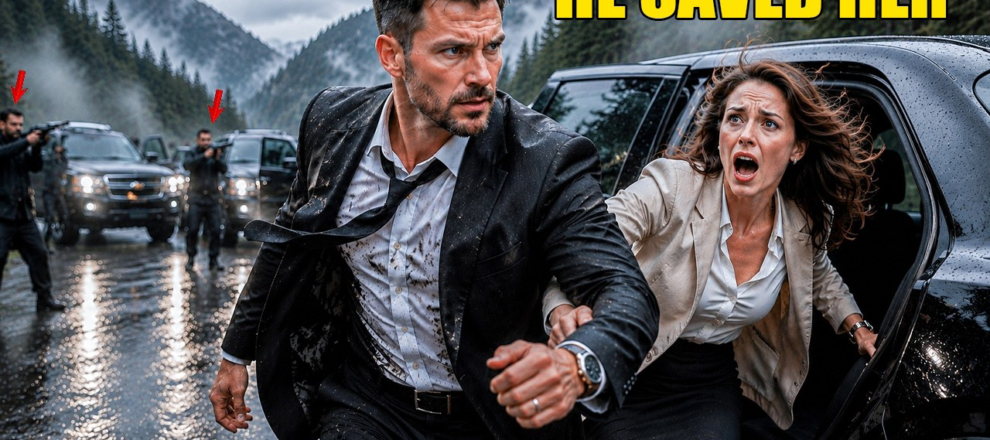
She heard him say her name once, very clearly, and then her door was open, and his hand was on her arm, and they were moving not running in the panicked way of people fleeing, but moving in the controlled, directional way of people executing a plan.
He took her into the tree line at an angle that put the bulk of the stopped car between them and the remaining shooters.
And then they were into the forest, and the darkness swallowed the road behind them.
He had been hit.
She didn’t know it for almost 20 minutes, not until they had covered enough ground that he allowed them to stop.
And she saw the way he was holding his left arm against his body, with a stillness that was not natural.
She reached for his jacket.
He let her.
The wound was in his upper left arm a through and through, that had missed the bone, but had torn through muscle with enough force to bleed seriously.
She took off her scarf, folded it with fingers that were shaking less than she would have expected, and pressed it against the entry point.
He told her calmly how to apply the pressure.
She applied it.
He leaned back against the trunk of a large tree, and looked up through the canopy at the lightning sky and said, good, that’s good.
They found the cabin by following the tree line south for two hours, moving slowly because of his arm, and because he insisted on intervals of stillness, during which he listened to the forest in a way that she gradually understood was not instinct, but methodology.
A way of reading the information that the night air carried.
The cabin was a hunting shelter, long unoccupied, with a rested cot and a propane lantern that still held gas in a first aid kit on a shelf that was dusty but intact.
She cleaned the wound with supplies that were inadequate for the task but sufficient for the night.
He did not flinch.
She did not look away.
It was in the cabin.
In the strange suspended quality of an emergency that had moved past its worst moment, and had not yet resolved into its next one, that they talked for the first time without agenda.
Evelyn had spent so many years as a professional in rooms, in negotiations, in the precisely-managed performance of competence that she had almost forgotten what it felt like to simply be in a conversation that no one was winning.
Daniel spoke about Holt, with a restraint that made it clear how much he had never spoken about him, about the particular weight of a mistake that cannot be undone, and can only be carried differently as the years pass.
She told him about a woman named Margaret, who had once been her closest friend, and her CFO simultaneously.
And who had sold a block of inside information to a competitor during Evelyn’s third year in business, and how the loss of the friendship had hurt far more than the financial damage, how it had taught her to keep the two categories entirely separate, the people she needed, and the people she trusted, and how she had been maintaining that separation ever since, an enormous personal cost, because it seemed like the only protection that actually worked.
He listened without offering solutions.
That surprised her more than anything else he had done.
She had grown so accustomed to people who responded to her vulnerabilities with advice, with strategy, with the implicit suggestion that her emotional states were problems requiring management that she had stopped sharing them.
He just listened, and she found herself talking longer than she had intended.
About things she had not said to anyone in years, in a burned-out hunting cabin, in a dark forest, while the man she was talking to held a field dressing against his arm, and looked at her with the particular attention of someone who had learned very thoroughly that what people said and what they meant were two different languages that required separate fluency to navigate.
He told her about his daughter.
Her name was Lily.
She was nine years old.
She liked astronomy, and was deeply disappointed that her father had not personally met any astronauts, and she had once asked him why he was always watching doorways when they said in restaurants.
He had told her it was a habit from when he traveled for work.
She had said, you watch every doorway.
Like you’re expecting someone bad to come through it, he had said, I’m expecting no one bad.
I’m just making sure.
She had looked at him with the uncomplicated clarity of a nine-year-old and said, that sounds exhausting.
He had agreed that it was, Evelyn left, not the polished, social laugh she deployed in professional settings, but the real one, shorter and slightly surprised that emerged when something caught her genuinely off guard.
He looked at her when she laughed, and he didn’t look away quickly the way people did when they were being careful.
He looked at her the way he looked at everything.
Steadily, without agenda, taking in what was actually there, it was in that cabin with the propane lantern casting its uneven light, and the wound in his arm throbbing in a way he did not mention that he told her what he had figured out.
It was not an outside operation.
It was inside.
The information about her route to the Ashford resort, including the specific backroads he had chosen himself, which he had not shared with anyone at the firm had been communicated to the attack team in advance.
He had made the route decision at 11 o’clock the night before departure.
By the time he had checked his phone at one in the morning, there was already a anomalous data activity on the firm’s internal scheduling server.
Only someone with executive level access to that server could have seen the updated route.
And only three people in the firm had that level of access at that hour.
She knew before he finished.
She knew because of the way a particular name had been sitting in the back of her mind for three weeks.
In the uncomfortable way that an unexamined true occupies mental space, taking up room without being looked at, Richard Galaway, 47 years old, chief strategy officer for the past six years.
The person she had promoted over 11 others because of his intelligence and his apparent loyalty.
The person who had sat across from her in 46 board meetings.
Who had helped her build the hargrove deal from its earliest conceptual stages.
And who she understood now with a sudden, seconding clarity had understood from the beginning exactly what it was worth to someone who wanted to acquire it through other means.
She sat with this for a long time.
Daniel waited.
He was very good at waiting.
They left the cabinet first light.
Daniel had made contact through a secondary communication method, a protocol he had not explained to her, and which she had not asked about, and by the time they emerged from the tree line onto a logging road two miles from the highway, a vehicle was waiting, not police, not corporate security.
Someone older, quieter, with a face like weathered rock.
And the manner of a man who had spent so many years in classified situations that the classified quality had become permanent, a man who greeted Daniel with a single nod, and helped him into the passenger, seat without ceremony.
He looked at Evelyn once, with an assessment that was not unfriendly but was completely impersonal.
And then he drove.
What Daniel did over the following 36 hours was something Evelyn witnessed only partially and understood even less fully.
She knew that he left the safe house twice in a vehicle she did not recognize.
She knew that what he brought back on a secure drive and in a series of photographs taken with a camera, she had never seen him carry constituted comprehensive evidence of Richard Galois arrangement with a compete holding group called Meridian Strategic Partners, a four-year conspiracy that included the sale of proprietary deal intelligence, the deliberate sabotage of three previous transactions.
And the coordination of the attack on her car, she knew that federal investigators, once contacted through channels that she suspected were not the standard FBI tipline, responded with a speed that suggested they had already been watching Meridian for reasons unrelated to Evelyn Carter but very related to several other things.
She did not know, and did not ask, what exactly Daniel had done to obtain what he had obtained.
She understood that the question was one he would answer honestly but incompletely.
And that the incompleteness was not deception, it was structure.
Some information existed in categories that had no civilian translation.
She did her own part, while Daniel was doing his, she had spent 12 hours on encrypted channels with her legal team and her most trusted technology analyst, executing a sequence of financial maneuvers that effectively locked every account with which Meridian Strategic Partners had any transactional relationship, triggered a series of compliance flags across three regulatory bodies, and placed the entire Hargrove deal into a protective legal structure that made it impossible for any third party to access or interfere with it, regardless of what happened to her personally.
She had also, with precise and unhurry deficiency, compiled a financial portrait of Richard Galaway’s last four years that was so complete and so damning that her attorney, upon receiving it, had said simply, I need to sit down, she had said, take a moment, then call the prosecutors, the ending when it came was not cinematic.
There was no single confrontation with a perfect dramatic resolution.
There was instead a sequence of events over 48 hours that moved with the institutional thoroughness of legal process.
Galaway’s arrest, the detention of three Meridian executives, the seizure of servers and financial records, the careful unwinding of a conspiracy that had been four years in the making, and would take considerably longer to fully prosecute.
The attack team that had ambushed them on the mountain road was traced through a contractor network that federal investigators had been following for 18 months in connection with three other cases, and every member of it was identified and located within a week.
The Hargrove deal was completed on a rescheduled date that Evelyn’s lawyers described as a minor administrative adjustment and which the financial press described accurately as a historic consolidation.
There was one moment that was not institutional.
Daniel had gone back in the last phase of the operation to a location she was not told about in advance, a secure facility where the physical evidence of Meridian’s scheme was being held by intermediaries who were not yet ready to hand it to federal custody.
Held instead by people who operated in the particular gray space that Daniel had spent 11 years inhabiting and had never quite fully left.
He had gone alone.
He had come back.
Whatever had happened there, he had come back with everything they needed, and a long shallow cut along his right forearm that he dismissed as a doorage and that she did not believe for a second but chose not to contest.
He had also come back looking like someone who had made a decision that had been a long time coming.
Not at peace, exactly.
But at rest.
The difference she was beginning to understand was everything.
She offered him the position of Chief Security Officer three days after the arrests.
It was a serious offer, the title, the compensation.
The full infrastructure of a major corporation rearranged around a role designed specifically for the competencies he possessed.
He listened to her lay it out in its entirety, which she did with the same precision she brought to every significant decision, and then he was quiet for a moment, and then he said, no, she had expected this.
She said, why?
He said, because I’m not that person anymore.
She said, the person who just dismantled a multi-year criminal conspiracy and got federal charges filed in 48 hours, he said, the person who needs to be that person to do his job.
She looked at him for a long time.
She said, what do you want to do?
He said, drive.
Spend weekends with my daughter.
Sleep through the night occasionally.
She said, that sounds like a plan.
He said, it’s a start.
What happened between them did not happen quickly or dramatically.
It happened in the accumulative way of two very careful people who had both been burned by trusting too much and too soon, and who were both for the first time in a long time, in the presence of someone who seemed to require nothing from them that they were not willing to give.
It happened in conversations during long drives.
In the particular silence of early mornings before the city woke up, in a lunch that was supposed to last 45 minutes and lasted three hours without either of them noticing the time pass.
It happened the afternoon Evelyn Met Lily, who shook her hand with great formality, and then after approximately 90 seconds of assessment asked her if she knew anything about the Messier catalog and Evelyn, who had read widely and forgotten nothing since the age of seven, said she knew quite a lot about it and Lily said, dad, I like her, and Daniel said nothing, but looked at a point approximately four inches above Evelyn’s left shoulder, in a way that she had come to recognize as his version of smiling when he was genuinely moved.
She did not try to change him.
He did not try to change her.
They were both past the age and past the experiences that made that kind of project feel worthwhile.
What they found instead was something quieter and more durable.
The particular ease of two people whose defenses, once carefully established, could be laid down in each other’s company without either person having to make a speech about it.
He still watched doorways.
She still worked 70 hour weeks.
He still drove her to the office every morning, and was still the best driver she had ever had, not because she was requiring him to stay in that role, but because he had told her, with his characteristic directness, that he found the morning’s useful, the quiet, the movement, the reliable structure of a day that began the same way, and allowed everything afterward to be different.
She had nodded, and filed it in the same category, as all the other things about him, that she had stopped trying to fully translate and had simply accepted as true.
One year later, on a clear October morning with the kind of light that makes Manhattan look briefly like a place where only good things happen, Daniel drove Evelyn to the opening of the Carter Foundation’s inaugural Community Fund.
An organization she had been conceptualizing for four years, and had finally built a financial literacy and mentorship program for first-generation college students that had already committed funding to 260 young people in its first operating quarter, the building was new, the ribbon was red, and a small crowd had gathered that included several people who had in various ways.
Shaped the years that had brought her here.
Her attorneys, her most trusted analysts, Patricia from the firm, and a nine-year-old girl named Lily, who had been permitted to skip school for the occasion, and who was wearing a dress, she had selected herself, and was standing very straight because she understood, in the way children sometimes understand consequential moments, that this was one, a journalist from a financial publication caught Evelyn outside the entrance, just before the ribbon cutting.
She had a press badge and a recorder, and the slightly breathless manner of someone who had been told this story was bigger than it looked.
She asked three questions in rapid succession about the foundation.
About the Hargrove merger, about what the last year had meant for the firm strategic direction, and Evelyn answered all of them with the precise, controlled fluency of someone who had been talking to journalists for 15 years, and knew exactly what she was willing to give them.
Then the journalist looked down at her notes and said, with the slight hesitation of someone who is decided to ask the personal question, is there anyone in particular who has been most significant, most important to you, personally, in this chapter of your life, Evelyn was still for a moment?
Not thinking about what to say, she had not prepared an answer because she had not anticipated the question, and she found somewhat to her own surprise, that she did not need to.
She looked across the small plaza to where Daniel was standing beside the car, in his jacket, watching the crowd in the way he always watched crowds, not with suspicion anymore, or not only with suspicion, but with the particular attentiveness of someone who had learned that the world was worth paying attention to, that most of what was in it was not a threat, that most mornings ended the same way they began, and that this was not monotony but grace.
He felt her looking, he turned.
He didn’t wave or make a gesture.
He just looked back at her with the same steadiness he had brought to everything.
From the first morning in the parking structure to this one, she turned back to the journalist.
She said, there is someone.
The world would look at him and see a driver, she paused, and the journalist’s recorder light was still red, and the October light was doing something generous to the plaza, and somewhere behind them, Lily was explaining the Messier catalog to Patricia with the inexhaustible confidence of a nine-year-old who has found a receptive audience.
He sees everything I miss, Evelyn said, he walks into a room and knows exactly what’s in it, and he still chooses to stay.
That is rare than anything I’ve ever built.
The journalist wrote this down, she wrote it down carefully, as if she understood it was not a quote about a professional relationship.
She was correct.
Daniel crossed the plaza.
He had heard none of it.
He had been too far away but he had read enough in her posture across the distance to know that whatever she had said had been true, and that was enough for him.
He stopped beside her.
She reached without ceremony, without declaration, without any of the complicated architecture she had built around herself over 20 years of learning not to reach for things, and she took his hand.
He let her.
They stood there in the October light.
In front of the building she had built, and the foundation she had started, and the crowd of people who represented everything that was possible when someone decided against all experience to trust again.
The journalist’s recorder was still running, neither of them noticed.
There were no more secrets, not the useful kind, not the protective kind, not the kind that carve out the interior space of a person, and leave them living in the shell.
What remained what they had found in the small hours of a hunting cabin, in 36 hours of parallel operation, in a year of early mornings and long conversations, and one nine-year-old’s frank assessment of a woman, her father had started looking at differently was not simple.
It was not uncomplicated, but it was real, and in the careful economies of two people who had paid very high prices for the things they had lost.
Real was the only currency that still held its value.
He had stopped carrying the weight of Holt’s death as a verdict, and had begun carrying it instead, as a fact, something that had happened, something that had shaped him, something that did not have to define the direction of every remaining day.
She had stopped maintaining the partition between the people she needed, and the people she trusted, because she had found in the most improbable of circumstances.
A person who dissolved that partition by existing outside the categories she had built it to manage, the ribbon was cut, the camera’s flashed.
Lily declared the building impressive, and immediately asked if there was food inside, the morning moved forward in the way mornings do.
Unhurried and specific and full of the small irreducible texture of things that are actually happening.
Daniel opened the car door at the end of it, out of habit, and Evelyn paused before getting in paused in the way she was learning to pause, taking a moment to simply be in it, rather than already planning the next thing, and she said quietly, not for anyone else.
Thank you.
He said, for what?
She said, for seeing what was there, he considered this.
He said, always, she got in the car.
He closed the door.
He walked to the driver’s side, and the city was loud around them, and the day was still full of whatever it was going to hold.
And there was nothing left to hide, and that was enough.
That was, against all odds, and by a long road neither of them would have chosen, exactly enough.
The weeks after the arrests were strange, in the way that all aftermath is strange.
Defined by the sudden absence of urgency, and the slow return of ordinary time, Evelyn’s office had the particular quality of a room that has been under siege.
And is now only a room again.
Her security team was restructured.
Her IT infrastructure was rebuilt from a clean baseline.
Three board members submitted quiet letters of concern, which she read with the composed attentiveness of someone who understood that expressions of concern from board members, after crises that had been successfully resolved, were primarily exercises in self-documentation.
She responded to each one with precision and patience, because she had learned a very long time ago, that the management of perception required the same strategic discipline as the management of capital, and she had also learned more recently, that the management of both left almost no time for the management of anything actually important, Daniel drove her every day through all of it.
He was quieter than usual in those weeks, in the way of someone processing something that had no convenient external form.
She did not push.
She had watched him in the moment, when the federal case had been formally handed over the point at which the evidence was no longer his to carry, but the governments, and she had seen something in his face that she recognized from her own history, as the expression of a person setting down a classics, wait they had been carrying so long they had stopped noticing the strain of it.
He drove.
She worked from the backseat.
The city passed in its usual overwhelming abundance of detail, and somewhere in the rhythm of it, they both found a kind of equilibrium that was not declared or announced but was simply present.
The way things are present, when they have been built out of real materials, rather than wishful ones.
Patricia, who had worked for Evelyn for nine years, and had developed the calibrated perceptiveness of someone who survived in close proximity to a very demanding principle by reading everything correctly, noticed the change approximately six weeks in.
She did not say anything about it directly.
She was far too intelligent for that, but she began scheduling Evelyn’s morning departures, with a slightly longer window than was technically necessary, and she ensured that the afternoon return from the office was at an hour that allowed for the kind of unhurried departure that suggested the driver’s company was not a burden, but a preference.
Evelyn noticed this.
She said nothing.
Patricia understood that the absence of a correction was the correction, what changed Evelyn most in the months after the crisis was something she had not anticipated and could not have predicted from the outside, which was the discovery that she had been operating for a very long time at a level of sustained vigilance that she had ceased to recognize as vigilance and had simply incorporated into her baseline definition of consciousness.
She had been alert to threats so continuously, so completely that the state of alert had come to feel like normal, and she had mistaken the absence of rest for the presence of strength.
The way people sometimes mistake the running of a machine for evidence of its efficiency rather than evidence of its wear.
Daniel, who had lived inside that kind of vigilance at a level that made hers look modest.
Understood this without her having to articulate it, he had come out the other side of it, not unaffected, not unchanged, but out the other side and what he carried now was something different from vigilance, a quieter, and more discriminating awareness that could distinguish between the things that required watching, and the things that could simply be allowed to be.
She found herself learning this from him through a form of proximity that had no formal name.
She started sleeping six hours instead of five.
Her physician noted the improvement with visible relief.
She said nothing about its source.
The federal prosecution of Richard Galaway proceeded through its early stages, with the methodical deliberateness of a case built on evidence so comprehensive that the outcome was not really in question.
Only the duration.
Galaway himself had engaged four attorneys and was maintaining his silence with the discipline of someone who understood that the space between a rest and trial was the only space in which he retained any agency.
Evelyn had been advised by her legal team to have no contact with the case beyond what was required for her testimony.
And she followed this advice with the same precision she brought to legal guidance she agreed with, which was the only kind she followed.
She sat for her initial testimony on a Tuesday morning.
Answered every question with the factual completeness of a person who had been keeping very good records and left the federal building at 1145, feeling something she had expected to feel far more intensely, a kind of closure that was actually more like a closing the shutting of a door on a chapter, not the resolution of everything that had been inside it.
She told Daniel about it on the drive back.
Not the legal content.
She was not permitted to discuss that, but the experience of it.
The strange formality of being in a room where the thing that had been done to her was being translated into institutional language.
He listened and then he said something she thought about for a long time afterward.
He said, the formal accounting is never the real one.
She asked what the real one was.
He said, the one you make with yourself about what you did with what happened.
She looked at him in the mirror.
She said, what did you do with it?
He said, I drove you to work.
I kept you alive long enough to finish something worth finishing.
He paused.
That’s not nothing.
She said, no, it’s not.
And they drove the rest of the way in the particular silence that had become between them, a form of conversation in itself.
She began accompanying Lily to the observatory on alternating Saturday mornings.
This had not been planned, but had evolved from a single visit that Lily had engineered with a nine-year-old’s transparent tactical, inosalce, and which had resulted in Evelyn spending three hours in a state of genuine absorption that she had not experienced in any environment outside of high stakes negotiation.
Lily was an excellent guide.
She had very strong opinions about which features of the night sky were underrated and which ones received disproportionate attention relative to their actual significance.
And she communicated these opinions with the confident authority of a person who has recently become expert in something and has not yet learned to modulate their certainty for the comfort of less knowledgeable audiences.
Evelyn found this completely charming.
She also found that the observatory on those alternating Saturday mornings was one of the few places where she consistently forgot to check her phone.
Daniel watched them from the doorway of one of the observation decks one Saturday.
His daughter holding a star chart at an angle that required her to tilt her head 45 degrees.
Evelyn crouched beside her, pointing at something in the upper left quadrant of the chart and saying something that made Lily’s face go from critical concentration to outright delight in about two seconds.
He stood there for a moment longer than he needed to.
Storing the image in the careful way, he stored things that mattered not for retrieval under stress, but for retrieval in the ordinary moments of an ordinary life.
The ones that gave the whole structure its actual meaning.
He had been a man for whom the world was primarily a set of threats and variables to be managed.
He was learning, slowly, and with the assistance of people who had no idea they were teaching him.
To be a man for whom the world was primarily a place where things of genuine value could be found if you were willing to look.