
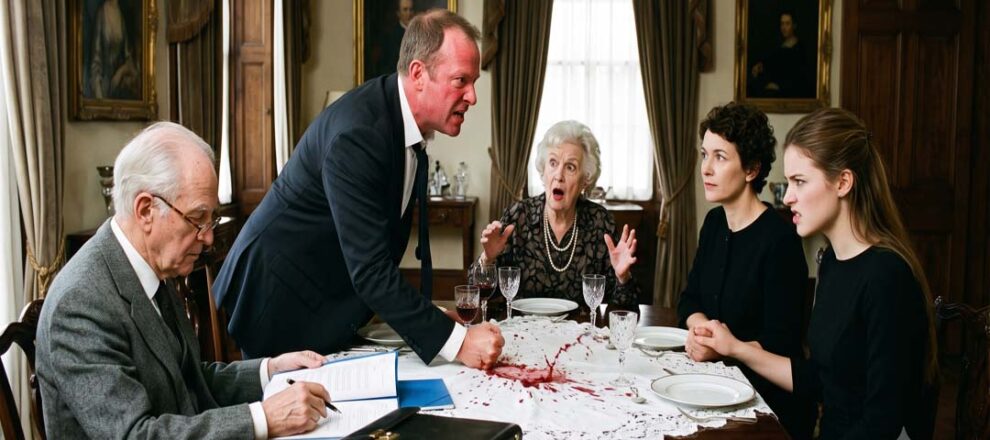
Until the Reading of My Late Husband’s Double Will Exposed Who Really Owned the Empire
PART 2: THE SHADOW OF THE PAST & HIDDEN MOTIVES
To understand the rot inside Oakridge Manor, one had to look back thirty years.
In 1996, when Arthur brought me to this house for the first time, Eleanor had refused to come downstairs to meet me. She had left a note on the silver tray in the foyer: “Arthur, tell your guest that servants use the side entrance.”
They assumed I was a nobody because I didn’t carry a socialite surname. What Eleanor and Julian never bothered to learn was that my father, Thomas Vance (a distant, estranged branch of the same founding family), had owned the original textile mills that funded the entire Westchester development in the early 20th century. When the mills collapsed in the 1970s, my father took on massive debts to pay off his workers’ pensions, leaving us broke in material wealth, but rich in honor.
When Arthur found me working as an archival researcher at the state historical society, he fell in love not with a status symbol, but with a woman who understood the soul of old things—who knew how to repair what was broken.
Arthur knew his family was drowning in toxic vanity. His father, Arthur Sr., had been a gambler who leveraged the family business to the brink of bankruptcy before his death in 1995. To save the family from public disgrace, Arthur II—my husband—had worked eighteen-hour days as a structural design consultant, pouring every penny of his earned income into paying off his late father’s shadow debts, maintaining Oakridge Manor, and funding Julian’s wildly unsuccessful commercial real estate ventures.
Meanwhile, Eleanor kept up the illusion of grandeur. She hosted charitable galas on credit, bought designer gowns while the roof of the west wing leaked, and endlessly praised Julian as the “financial genius” destined to restore the family name. Julian, of course, was nothing more than a glorified gambler. Over two decades, he systematically siphoned millions from the family trust’s investment portfolio, covering his losses by persuading Eleanor to sign over secondary mortgages on various family land holdings.
Arthur watched it all happen. He tried to reason with them, but Eleanor blinded herself to Julian’s failures while treating Arthur as a workhorse whose sole purpose was to fund his brother’s vanity and his mother’s pride.
“Why do you put up with it, Artie?” I asked him one late night five years ago, as we sat in his private study in the old barn—a sanctuary I had spent months renovating with my own hands.
Arthur had smiled a weary, heartbreaking smile, his eyes reflecting the glow of the desk lamp. “Because, Nora, arrogant people always dig their own graves. They just need enough rope. They think they own this world because their name is on the gate. They don’t check the land registry. They don’t read the fine print. They only look at the gilding on the mirror.”
He had pulled a heavy, velvet-lined steel box from behind a row of leather-bound architecture folios. Inside were hundreds of yellowed pages, legal deeds, bank ledgers from the 1980s, and a sealed manila envelope bearing the red wax stamp of a prestigious Manhattan law firm.
“What is that?” I had asked.
“This,” Arthur said, laying his hand gently on the box, “is the true history of Oakridge Manor. My mother thinks she owns this house. Julian thinks he’s inheriting an empire. When I am gone, Nora, they will come for you like wolves. They will try to throw you out with nothing. But when they strike, I want you to unlock this box.”
Three months before Arthur died, while he was confined to his bed and Eleanor was out at a bridge tournament, a young courier had delivered a final document to the house. Arthur signed it with a trembling hand, looked up at me, and kissed my wrist.
“They called you a maid, Nora,” he whispered, his eyes burning with a sudden, fiercesome clarity. “Now, let them see who built the house.”
PART 3: THE CONFRONTATION & THE TIDE TURNS
The heavy oak doors of the dining room creaked open right at four o’clock.
In walked Mr. Harrison Vance-Sterling, an eighty-year-old senior partner at Sterling, Ross & Vance—the oldest law firm in New York. He carried a battered leather briefcase and was accompanied by a sharp-eyed young woman carrying a stack of thick, blue-bound legal dossiers.
Eleanor instantly straightened her back, adopting the regal demeanor she reserved for social equals. “Ah, Harrison. Thank you for coming down personally. I assume this won’t take long? We would like to wrap up the formal proceedings so Julian can begin reviewing the estate’s asset portfolio.”
Harrison did not smile. He pulled out a pair of half-moon reading glasses, sat down at the foot of the table opposite Eleanor, and nodded politely to me. “Good afternoon, Nora. Clara. Mrs. Vance.”
“Let’s skip the pleasantries, Harrison,” Julian said smoothly, leaning back and crossing his legs. “We’re all aware of the 1998 family trust agreement. My late father and brother established that Oakridge Manor and the underlying trust assets pass down through the male line to maintain the structural integrity of the Vance legacy. Nora is entitled to her statutory survivor allowance, which we are prepared to honor today.”
Harrison looked over the rims of his glasses at Julian, then at Eleanor. “Julian, the 1998 agreement you are referring to was rendered null and void twelve years ago.”
A sudden, sharp silence fell over the room. The air grew thick and heavy.
“What do you mean null and void?” Eleanor snapped, her voice losing its polished edge. “I signed that document myself! I am the living matriarch!”
“You signed a document regarding assets you believed you owned, Mrs. Vance,” Harrison said calmly, opening his briefcase and withdrawing a thick stack of certified legal documents. “However, a thorough forensic audit initiated by Arthur in 2012 revealed something quite different.”
Harrison pulled out a bright blue document bearing an official state seal.
“First,” Harrison began, his voice ringing through the dining room like a church bell, “let us address Oakridge Manor itself. In 1992, your late husband, Arthur Sr., took out a secret four-million-dollar mortgage on this house with an offshore lender to cover his catastrophic losses on Wall Street. The house was facing immediate, quiet foreclosure in late 1994.”
Eleanor’s face turned white. “That’s… that’s impossible. Arthur Sr. would never—”
“He did,” Harrison interrupted cold-bloodedly. “And to prevent his mother and teenage brother from being thrown into the street, my client, Arthur II, privately purchased the entire debt using his personal earnings from his commercial architectural patents. But he didn’t just buy the debt. He bought the entire fee simple title to the estate through a private holding corporation: N&C Historical Properties LLC.”
Julian stood up so fast his chair screeched against the hardwood floor. “What holding corporation?! What are you talking about? Oakridge Manor is a Vance family asset!”
“It was,” Harrison replied smoothly. “Until 1995. At that point, Arthur II became the sole owner of the land, the main house, the grounds, and every structure standing upon it. His mother, Eleanor, was permitted to reside here under a life-estate occupancy agreement—an agreement that was contingent upon one specific clause.”
Harrison looked directly at Eleanor. “The clause explicitly states that the life-estate occupancy remains valid only so long as Eleanor Vance treats the primary title-holders with dignity and does not attempt to liquidate or encumber property that does not belong to her.”
“Who owns N&C Historical Properties?” Julian demanded, his forehead glistened with a sudden sheen of sweat. “If Arthur owned it, then as his surviving brother and primary male heir—”
“Julian,” Harrison interrupted, leaning forward. “N&C stands for Nora & Clara. My client, Arthur Vance II, transferred 100% of the equity of N&C Historical Properties into an irrevocable private trust ten years ago.”
Harrison turned his gaze to me.
“Nora does not own a small stipend, Julian. Nora owns this house. She owns the land beneath your feet. She owns the west wing, the east wing, the stables, and the water rights. You, Eleanor, and your family are sitting in a house that belongs entirely to the woman you spent twenty-five years calling a maid.”
PART 4: THE DEEPER SECRET REVEALED
The dining room descended into absolute chaos.
“This is a fraud!” Victoria shrieked, jumping to her feet. “Julian, do something! This is a setup! That quiet little bitch orchestrated this whole thing!”
“Shut up, Victoria!” Julian roared, his face flushed purple. He turned on Harrison, trembling with rage. “This won’t hold up in court! My brother was sick! He was under undue influence! Nora manipulated him while he was dying!”
“Undue influence?” Harrison chuckled softly, a cold, dry sound. He reached into his briefcase and pulled out a heavy black leather notebook and a flash drive. “Julian, Arthur was not manipulated. He was meticulously, brilliantly prepared.”
Harrison plugged the flash drive into a laptop his assistant brought forward. A video screen lit up, displaying a high-definition recording taken eight months prior in Harrison’s law office. On the screen sat Arthur. He looked pale and thin, but his eyes were sharp, bright, and filled with unquestionable authority.
The audio played clearly through the room, Arthur’s deep, calm voice echoing off the high ceilings:
“If you are watching this video, it means I have passed, and my brother Julian and my mother have already made their move to strip Nora of her dignity and home. Let me set the record clear for any court or judge reviewing this file.
For twenty-five years, my wife Nora preserved this family. When my father died in disgrace, leaving us tens of millions in debt, it was Nora’s personal inheritance from her late father’s estate—a quiet trust fund she never bragged about—that paid off Julian’s tuition at Harvard, paid for Eleanor’s medical bills, and kept the foreclosing banks at bay.
Yes, you heard that correctly, Mother. The money you spent on your diamonds and galas for the last quarter-century did not come from the Vance trust. It came from Nora’s family. She allowed you to believe it was Vance money so that you could keep your pride. And how did you repay her? By treating her as a servant in her own house.
Julian, over the last fifteen years, you have embezzled approximately $3.2 million from the family’s residual maintenance accounts. I let you do it because I was tracking every transaction. Every fake invoice, every shell company, every offshore transfer—I have recorded it all.”
Julian dropped into his chair as if he had been struck by a physical blow. Victoria backed away from him, her mouth agape, staring at her husband as if he were a complete stranger.
On the screen, Arthur leaned closer to the camera.
“I executed a double will. The first will—the public one from 1998—was a test. I knew that if you thought Nora had nothing, your true colors would show instantly upon my death. The second will, executed in full mental capacity and witnessed by three independent medical professionals, revokes all previous documents.
Everything I own—my patents, my liquid accounts, the estate, and the rights to the family name—passes unconditionally to my wife, Nora, and my daughter, Clara. To Julian and Eleanor, I leave the truth. And the debt.”
The video screen faded to black.
Silence swallowed the room. Eleanor was shaking so violently her pearl necklaces clicked against her neck. She looked at me, her mouth opening and closing like a fish out of water, searching for words that had abandoned her.
“Nora…” Eleanor gasped, her voice barely a whisper, stripped entirely of its arrogance. “Nora… you… you knew?”
I looked at my mother-in-law. I didn’t yell. I didn’t gloat. I simply looked at her with the quiet, unyielding weight of twenty-five years of truth.
“I knew Eleanor,” I said, my voice smooth as silk. “I knew every time you made me sit at the lower end of the table. I knew every time you told the neighbors I was just ‘Arthur’s quiet assistant.’ I kept silent because Arthur loved you, and he wanted to give you a chance to prove you had a shred of decency left in your heart. But you never did.”
PART 5: RECKONING & THE NEW POWER BALANCE
Harrison tapped the pile of documents on the table. “Now, let us discuss the immediate legal consequences.”
He slid a bright pink legal document toward Julian.
“This is an explicit notice of civil fraud and a demand for full restitution of $3.2 million to the primary estate within thirty days,” Harrison stated. “If the funds are not returned, we will present this entire ledger—along with Arthur’s recorded deposition—to the District Attorney’s Financial Crimes Division. Furthermore, all credit cards, luxury vehicles, and allowance stipends funded by the holding company are terminated effective immediately at midnight tonight.”
Julian stared at the pink document, his eyes wild with terror. “3.2 million?! I don’t have three million dollars! Everything I have is tied up in commercial real estate that’s in foreclosure!”
“Then I suggest you retain a very good defense attorney, Julian,” Harrison replied coldly. “Because Nora has instructed us not to offer a single cent of compromise.”
Victoria slammed her hand on the table, turning on Julian with pure venom. “You lied to me! You told me you owned half of Westchester! You told me we were taking over this estate!”
“Shut up, Victoria!” Julian screamed.
“Don’t you tell me to shut up! I’m filing for divorce tomorrow!” She snatched her Hermes bag from the floor, turned on her designer heels, and stormed out of the dining room, her heels clicking furiously until the front door slammed shut behind her.
Julian bowed his head into his hands, sobbing uncontrollably. His adult children, Tristan and Chloe, looked terrified, realizing in an instant that their trust funds, their tuition payments, and their easy luxury lifestyles had vanished into thin air.
Harrison then turned to Eleanor.
“Mrs. Vance. As for your life-estate occupancy of Oakridge Manor: because you have actively violated the terms of the agreement by attempting to sell off estate assets—specifically the mid-century Georgian silver and the west wing art collection—your life-estate is hereby revoked.”
Eleanor’s eyes went wide. She clutched her chest. “You… you are throwing me out? Of my own home?!”
“It is not your home, Eleanor,” I said, standing up from the table for the first time. I stood tall, my head held high, looking down at the woman who had spent decades trying to make me feel small. “It is my home. It is Clara’s home.”
“Nora… please,” Eleanor wept, tears finally spilling over her wrinkled, heavily powder-dusted cheeks. “I am eighty-two years old… where will I go? What will people say?”
“You will go to the cottage at the far edge of the property,” I said calmly. “The old caretaker’s house. It has two rooms, a small kitchen, and a garden. I have had it renovated and furnished. It is quiet, modest, and safe. You will be given a monthly pension of three thousand dollars—enough for food, medicine, and modest clothes. But you will no longer enter this main house. You will no longer command servants. And you will never, ever speak down to my daughter again.”
“The caretaker’s cottage?” Eleanor choked out, devastated. “That’s… that’s where the staff lived!”
“And for twenty-five years, Eleanor, you treated me like the staff,” I replied, my voice cool and sharp. “Now you will learn what it truly means to live simply. If you refuse these terms, Harrison will proceed with the immediate formal eviction and the recovery of all family jewels that were purchased using my father’s funds.”
Eleanor looked at Julian, who was weeping into his arms. She looked at her grandchildren, who were looking away in shame. She looked at Clara, who sat dignified and proud beside me.
She realized she had no cards left to play. Her empire was built on quicksand, and the tide had come in.
“I… I accept,” Eleanor whispered, her head drooping in complete defeat.
PART 6: THE TRUE LEGACY
Three months later, the early morning sun broke over the eastern hills of Westchester, casting long, golden ribbons of light across the vast green lawns of Oakridge Manor.
The main house was quiet, but it was no longer heavy. The dark, oppressive air of toxic vanity had lifted like a morning fog.
I stood on the stone veranda, holding a hot cup of black tea, listening to the birds singing in the ancient oak trees. The caretaker’s cottage was barely visible through the distant tree line—a small, humble chimney sending a thin wisp of smoke into the clear blue sky. Eleanor lived there now, spending her days tending to a small rose garden, stripped of her pretenses, visited only occasionally by quiet social workers and Clara, who, out of the sheer goodness of her heart, brought her grandmother fresh soup every Sunday afternoon.
Julian had been forced to declare personal bankruptcy. To avoid criminal prosecution for corporate fraud, he surrendered his remaining assets, took a job as a mid-level analyst at a firm in Ohio, and moved into a rented two-bedroom apartment, completely abandoned by his high-society friends and ex-wife.
Clara came out onto the veranda, wrapping a soft knitted shawl around her shoulders. She slipped her arm through mine and rested her head on my shoulder.
“The historical land trust called this morning, Mom,” Clara said softly. “They approved the application. The entire sixty acres of Oakridge Manor is officially registered as a permanent nature preserve and historic restoration center. No developers can ever touch it.”
I smiled, feeling a deep, profound warmth wash over my chest. “Your father would be so happy, Clara.”
“He knew what he was doing, Mom,” Clara whispered. “He knew you were the only one strong enough to save this place from being torn apart by greed.”
I looked out over the land that my husband had protected, the land that my father’s quiet sacrifice had preserved, and the future that now belonged entirely to my daughter.
For twenty-five years, they had looked at me and seen only a penniless maid—a woman who cleaned their tables, washed their dishes, and endured their quiet cruelty. They had mistaken my silence for weakness, my patience for ignorance, and my humility for defeat.
They had forgotten the simplest, most enduring truth of human nature:
True power does not scream from the head of the table; it sits quietly in the shadows, waiting for vanity to destroy itself, holding the keys to the kingdom all along.