PART 2:
The doctor’s question hung in the corridor like a door opening onto a life I had never imagined.
“Which one of you is the baby’s father?”
Madison turned toward me slowly. Her face had lost all color, but I barely registered her expression. All I could see was the blood on the doctor’s gloves and the controlled urgency in his eyes.
“I am,” I said.
The words came before doubt could stop them.
The doctor looked at me sharply. “Name?”
“Adrian Ashford.”
He checked the tablet in his hand. “The patient listed no father and no emergency contact. Are you certain?”
My throat tightened. “The timing fits.”
“That is not the same as certainty.”
“No,” I admitted. “But I need to know whether she’s alive.”
His expression softened slightly, though his voice remained firm. “Elena is alive. For now. Her heart is struggling to pump effectively, and the pregnancy is placing additional stress on it. We may need to deliver the baby tonight.”
“Tonight?” I stared at him. “She’s only thirty-four weeks.”
“That is why we are moving carefully. But if we wait too long, we could lose them both.”
The floor seemed to tilt beneath me.
Madison made a small sound behind me, but I did not turn around.
“What do you need from me?” I asked.
“At the moment, nothing. Since you are not legally her husband and she has not identified you as an authorized decision-maker, you cannot consent on her behalf.”
“I understand.”
The doctor studied me, perhaps expecting an argument.
A year earlier, I would have given him one. I would have called hospital administrators, board members, donors, anyone whose influence might have forced those doors open. I would have treated access like another problem money could solve.
But Elena was beyond those doors, fighting to breathe. This was not a boardroom, and her life was not a contract.
“Can you tell her I’m here?” I asked.
“If she becomes stable enough to speak.”
“When,” I corrected quietly. “When she becomes stable.”
The doctor gave a restrained nod and disappeared through the doors.
Silence settled around us.
Then Madison said, “You knew.”
I finally faced her.
She stood beneath the harsh corridor lights, one hand pressed against her stomach. The pain that had brought her to the hospital appeared forgotten.
“I didn’t,” I said.
“But you ran after her.”
“Because I recognized her.”
“You looked at that baby and immediately said it was yours.”
“I counted the months.”
Madison’s eyes filled, though her tears did not fall. “So there was overlap.”
“No.”
“You were with her while you were with me.”
“I met you after the divorce.”
“After the papers were signed,” she said bitterly. “That doesn’t mean you had let her go.”
I could not answer, because we both knew the truth.
I had never let Elena go. I had only buried everything beneath work, noise, and a relationship that demanded little honesty from me.
Madison looked toward the operating-room doors. “Did she leave because she was pregnant?”
“I don’t know.”
“What do you know, Adrian?”
The question was quieter than her anger, and more difficult to face.
“I know our marriage ended because I was never there when she needed me,” I said. “I know she stopped asking me to come home because she got tired of being disappointed. I know the last night we spent together happened after the divorce hearing, and neither of us planned it.”
Madison folded her arms around herself.
“And I know,” I continued, “that if Elena believed she had to go through this alone, then I gave her reasons to believe it.”
For once, Madison did not respond immediately.
Jonas stood several feet away, pretending to study the vending machines. My security team had withdrawn to the far end of the hall, their dark suits drawing uneasy looks from passing nurses.
Madison took a slow breath. “I should leave.”
“You came here because you were in pain.”
“The nurse said it was probably a stomach virus. She was arranging tests before you ran away.”
“I’ll make sure someone stays with you.”
“I don’t want one of your employees.”
“Then I’ll call your sister.”
She looked at me as if searching for something that might persuade her to stay. Whatever she hoped to find was not there.
“Were you ever going to love me?” she asked.
The question landed without accusation.
That made it worse.
“I cared about you.”
“That isn’t what I asked.”
I glanced at the doors again.
Madison gave a sad, knowing smile. “There’s my answer.”
She removed the slim gold bracelet I had given her two weeks earlier and placed it on the reception counter.
“I hope she survives,” she said. “I mean that. But after tonight, don’t call me.”
She walked away before I could offer an apology too small to matter.
Jonas approached once the elevator doors closed behind her.
“That could have gone worse,” he said carefully.
I looked at him.
He sighed. “Not the time.”
“No.”
He sat beside me. For nearly fifteen years, Jonas Hale had worked as my chief of security, adviser, and occasional conscience. He had seen me make decisions that frightened everyone else in the room, but he had never hesitated to tell me when I was wrong.
Tonight, even he seemed uncertain.
“Did you know?” I asked.
“About the pregnancy? No.”
“But you knew where Elena was.”
His gaze shifted.
The movement was slight, almost invisible, but I had known him too long.
“Jonas.”
“I knew she was in Chicago.”
My pulse changed. “Since when?”
“Three months after the divorce.”
I stood so quickly the chair scraped across the floor.
“You found her?”
“She contacted me.”
The anger rose instinctively, hot and familiar, but I forced myself to lower my voice.
“Why?”
“She needed help with something.”
“What kind of help?”
Jonas looked toward the nurses’ station. “This is not the place.”
“This is exactly the place.”
He rubbed a hand across his jaw. “She asked whether your security team was still monitoring her accounts.”
“I stopped that after the divorce.”
“I know. I told her.”
“And then?”
“She asked me not to tell you where she was.”
The words struck deeper than betrayal. “You agreed?”
“She sounded afraid.”
“Of me?”
“No.” Jonas’s answer came quickly. “Not of you.”
That stopped me.
“Then who?”
“She wouldn’t say. She only asked whether anyone connected to Ashford Holdings had tried to locate her.”
I stared at him. “Did they?”
“Not through my department.”
“That is not an answer.”
“It is the only answer I had.”
Before I could press him further, the emergency doors opened again. A nurse stepped into the corridor and called my name.
I crossed the distance immediately.
“Elena is conscious,” she said. “Only briefly. She asked for you.”
The relief was so sharp it hurt.
The nurse pointed toward the security team. “Only you. And you must remain calm. Her condition is unstable.”
“I understand.”
She led me through a maze of bright hallways. Machines sounded behind curtains. Nurses moved with practiced speed, speaking in clipped phrases that seemed both urgent and strangely ordinary.
Elena lay in a private trauma room surrounded by equipment.
For a moment, I could not move.
The woman I remembered had always carried warmth with her. Even when she was angry, even when she stood across from me in a courthouse wearing the blue dress she had once worn on our anniversary, there had been life in her face.
Now she looked almost translucent against the white pillows.
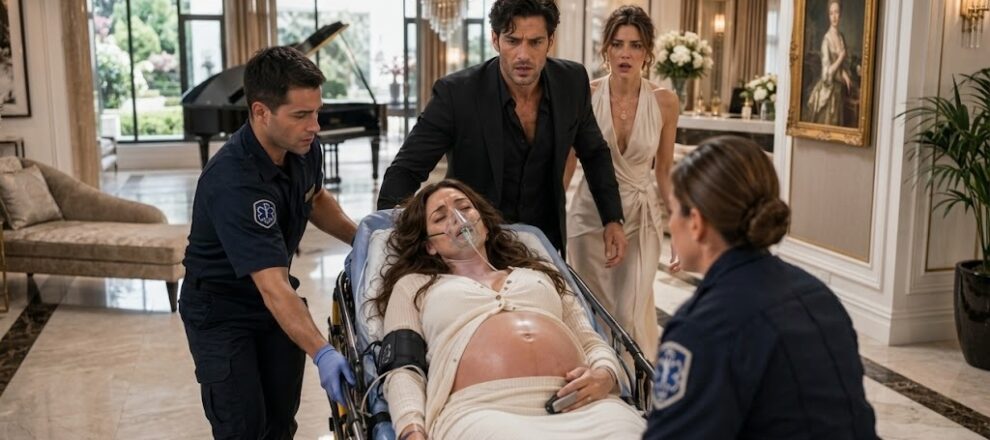
An oxygen mask covered her mouth and nose. Wires disappeared beneath her gown. Her stomach rose beneath the blanket, round and undeniable.
Her eyes found mine.
“Adrian.”
The mask blurred the sound, but I heard my name.
I stepped closer. “I’m here.”
Fear moved across her face. Not fear of me. Fear for the child.
“You shouldn’t be.”
“I saw them bring you in.”
She closed her eyes briefly. “Of course you did.”
The nurse adjusted a monitor and then withdrew to the doorway, giving us the illusion of privacy.
I stood beside the bed, afraid to touch her.
“Is the baby mine?” I asked.
Elena’s eyes opened again.
For several seconds, she simply looked at me. In that silence, I saw eight years of marriage, countless unfinished conversations, and every apology I had postponed because I believed there would always be another day.
“Yes,” she whispered.
The answer broke something inside me.
I gripped the bed rail to steady myself. “Why didn’t you tell me?”
Her gaze moved toward the ceiling. “I tried.”
“When?”
“The morning I left.”
“There was no message.”
“I came to your office.”
I shook my head. “You didn’t.”
“I sat in the lobby for almost two hours.”
Memory surfaced reluctantly.
The morning after our final night together, I had awakened alone in the hotel suite. My assistant had called about an emergency acquisition meeting. By noon, I was behind sealed conference-room doors while two companies fought over a merger worth hundreds of millions.
“I never knew,” I said.
“Elise said you refused to see me.”
My assistant.
The room suddenly felt colder.
“Elise told you that?”
“She said you wanted all personal matters handled through attorneys.”
“I never gave that instruction.”
Elena’s breathing quickened. A monitor changed rhythm.
The nurse took a step forward, but Elena lifted one hand weakly.
“I left a letter,” she continued.
“With Elise?”
“Yes.”
“I never received it.”
Her eyes searched mine, and I watched certainty give way to confusion.
“She called me afterward,” Elena said. “She said you had read it.”
“What exactly did she say?”
“That you believed the pregnancy was an attempt to stop the divorce. That you wanted proof before you would discuss anything.”
“I didn’t know you were pregnant.”
The monitor sounded again.
The nurse approached the bed. “We need to stop this conversation.”
Elena turned her head away, tears gathering at the corners of her eyes.
I leaned closer, keeping my voice steady. “Whatever happened, I did not reject you or our child. I swear to you.”
She looked back at me. “Then why would Elise lie?”
“I don’t know.”
That frightened me more than any answer.
The nurse placed a hand on my arm. “You must leave now.”
“Elena,” I said. “You are not alone.”
Her fingers moved across the sheet.
I took her hand carefully.
It was cold.
“You don’t get to make promises you can’t keep,” she whispered.
“I know.”
“Not anymore.”
“I know.”
Her grip tightened with surprising strength. “Save the baby.”
“We’re going to save both of you.”
“If they ask you to choose—”
“No.”
“Adrian.”
“No,” I repeated. “Do not ask me that.”
Her expression softened with exhausted sadness. “You always hated choices you couldn’t control.”
“And you always knew when I was afraid.”
The faintest shadow of her old smile appeared.
Then the monitor alarmed.
The room filled instantly. A doctor entered, followed by two nurses. Someone pulled me away as Elena’s eyes closed.
“Her oxygen saturation is dropping.”
“Prepare the operating room.”
“We’re delivering now.”
I was pushed into the hallway as the doors shut between us.
This time, I did not shout or demand answers.
I stood there holding the memory of her hand.
Jonas found me ten minutes later outside the surgical wing.
“They’re performing an emergency cesarean,” I told him.
He nodded, his expression grave.
“Elise lied to Elena.”
“What?”
“She told her I had rejected the pregnancy. She intercepted a letter and kept Elena out of my office.”
Jonas stared at me. “Are you certain?”
“Elena told me herself.”
He reached for his phone.
“Don’t call Elise yet,” I said.
“Why not?”
“Because I want to know what else she has hidden before she realizes we know.”
Jonas lowered the phone.
For years, Elise Monroe had controlled access to my schedule, correspondence, travel, and private meetings. She had been efficient, discreet, and seemingly loyal. I had trusted her with information I had never shared with friends.
Elena had disliked her from the beginning.
I had dismissed it as jealousy.
The realization tasted bitter.
“Check every communication from the month before the divorce until now,” I said. “Emails, visitor logs, deleted calendar entries, office cameras, everything.”
“That could take time.”
“Start with the morning Elena came to see me.”
Jonas nodded and moved away to make calls.
I remained outside the surgical wing.
Minutes lost their shape. Every time the doors opened, I looked up. Every footstep became a verdict. I thought about the nursery Elena and I had once planned in the east wing of our house, years before doctors told us natural conception was unlikely.
We had tried for three years.
Appointments, procedures, hopeful mornings followed by silent evenings. Elena had cried in locked bathrooms because she did not want me to see. I had responded by working longer hours, convincing myself that financial security was the same as comfort.
Eventually, she stopped mentioning children.
I assumed she had accepted it.
Now I understood she had simply learned to grieve without me.
At 1:06 in the morning, the surgeon emerged.
His mask hung loosely around his neck. Exhaustion lined his face.
I stood.
“The baby?” I asked.
“A boy. Four pounds, eleven ounces. He is breathing with assistance and has been transferred to the neonatal intensive care unit.”
A son.
The word did not feel real yet, but it opened something vast within me.
“And Elena?”
The surgeon hesitated.
My relief disappeared.
“She survived the delivery,” he said. “However, her cardiac function remains severely reduced. We have stabilized her, but the next twenty-four hours are critical.”
“Can I see her?”
“Not yet.”
“The baby?”
“A neonatal nurse can take you to him, provided you follow every instruction.”
I thanked him, though the words seemed inadequate.
The neonatal intensive care unit was quieter than I expected. Its soft lighting and muted alarms created a world separate from the hospital’s frantic corridors.
A nurse named Priya helped me wash my hands and put on a protective gown.
“Premature babies can look fragile,” she warned gently. “Try not to be alarmed by the equipment.”
I followed her to a clear incubator near the end of the room.
My son lay beneath a small knitted cap.
He was impossibly tiny. A breathing device covered part of his face, and sensors dotted his chest. One hand rested near his cheek, the fingers curled tightly as though holding on to something invisible.
I had negotiated with ministers and billionaires without trembling.
Standing beside that incubator, I could not control my hands.
“Can he hear me?” I asked.
“Probably. Babies recognize familiar voices, especially their mother’s. He may not recognize yours yet, but speaking softly can still comfort him.”
I moved closer.
“Hello,” I whispered.
The word sounded foolishly formal.
Priya smiled but pretended not to notice.
“I’m your father,” I continued. “I should have known about you sooner. That isn’t your fault. It isn’t your mother’s either.”
His fingers shifted.
I placed one finger through the opening in the incubator. His hand closed weakly around it.
Everything in me went still.
No business victory had ever felt like this. No possession had ever made me so aware of how little I truly controlled.
“I’m not going anywhere,” I told him.
The promise frightened me because Elena had been right. I had made promises before and mistaken intention for action.
This one would have to become a decision repeated every day.
Priya allowed me several minutes before guiding me away.
Outside the unit, Jonas waited with a tablet in his hand and a look I had rarely seen on his face.
“What did you find?”
“The visitor records confirm Elena entered your building at nine twelve that morning.”
“And left?”
“Eleven twenty-seven.”
“Did Elise meet her?”
“Yes. Lobby footage shows them speaking twice.”
He turned the tablet toward me.
The grainy image showed Elena sitting in a corner of the marble lobby, clutching a white envelope. She looked tired and uncertain. In the next frame, Elise stood beside her.
The final image showed Elena walking toward the exit without the envelope.
“Where is the letter?” I asked.
“We don’t know. But there’s more.”
Jonas opened another file.
“Elise accessed your private office after the acquisition meeting began. She remained inside for fourteen minutes.”
“That was not unusual.”
“No. But she also deleted a visitor notification from your internal account. Our backup server preserved it.”
The message was brief.
ELENA ASHFORD IS WAITING IN THE LOBBY. SHE SAYS IT IS URGENT AND PERSONAL.
My chest tightened.
The time stamp showed I had been sent the notification at 9:19.
“I never saw this.”
“It was marked as read from Elise’s terminal.”
“Why?”
Jonas’s expression hardened. “That is what we need to determine.”
I looked through the glass doors toward the neonatal unit.
“This was not about protecting my schedule.”
“No.”
“What else?”
“We checked outgoing calls from Elise’s office. She contacted Elena six times over the next month using an unregistered company line.”
“Elena changed her number after the divorce.”
“Elise apparently had the new one.”
I thought of Elena asking Jonas whether anyone connected to Ashford Holdings was tracking her.
“She believed someone was watching her.”
“It appears someone was.”
A familiar urge rose inside me: immediate confrontation, absolute answers.
But anger had already cost me too much.
“Do not approach Elise,” I said. “Restrict her access quietly. Copy every file she can reach. Find out whether she acted alone.”
Jonas studied me. “You’ve changed.”
“No. I’m trying to.”
A nurse appeared at the far end of the hall.
“Mr. Ashford?”
I went to her.
“Elena is awake,” she said. “She is asking about the baby.”
“Tell her he’s alive.”
“You can tell her yourself. Only for a minute.”
Elena had been moved to intensive care. She looked even smaller without the curve of pregnancy beneath the blankets.
When I entered, her eyes moved immediately to my face.
“The baby?”
“He’s alive,” I said. “A boy.”
Her lips parted in relief.
“He needs help breathing, but the nurse said he is stable. He held my finger.”
Tears slipped silently into her hair.
“He did?”
“Yes.”
“I wanted to name him Noah.”
I sat beside the bed. “Noah.”
“Do you hate it?”
“No. It’s perfect.”
She studied me. “You mean that?”
“I do.”
Her gaze drifted toward the window. Beyond it, Chicago glowed beneath a dark sky, indifferent to the lives changing inside the hospital.
“I had a room ready for him,” she said. “Not much. A crib from a secondhand shop. Yellow curtains. There are stars painted above the window.”
“I want to see it.”
“You don’t have to pretend.”
“I’m not pretending.”
“You have a life, Adrian.”
“So do you. So does Noah. I’m asking whether there is room for me in it.”
She closed her eyes.
“I don’t know.”
The answer hurt, but it was honest.
“I will earn the answer,” I said.
Her eyes opened again. “You cannot arrive with lawyers and schedules and decide what happens next.”
“I won’t.”
“You cannot move us into your house because it is convenient.”
“I understand.”
“And Madison?”
“It’s over.”
A flicker of guilt crossed her face. “Because of me?”
“Because I should never have begun something when I was still living inside the ruins of our marriage.”
Elena was silent.
Then she whispered, “I didn’t leave only because of Elise.”
I leaned forward.
“What happened?”
She glanced toward the door. “After I found out I was pregnant, someone entered my apartment.”
“Were you hurt?”
“No. Nothing valuable was taken.”
“What did they want?”
“They moved things. Opened drawers. Searched through papers.”
“Did you call the police?”
“Yes. They said there was no sign of forced entry.”
“Who had a key?”
“Only the landlord and me.”
Her breathing grew shallow, and I forced myself not to overwhelm her.
“What were they searching for?”
“I don’t know. But the next day, I received an envelope.”
“What was inside?”
“A copy of my medical report confirming the pregnancy.”
Cold unease settled through me.
“Was there a message?”
She nodded.
“What did it say?”
Her voice was barely audible.
“It said, ‘This child will destroy everything he built.’”
I kept my face calm for her sake.
“Do you still have it?”
“In a bank deposit box.”
“Why didn’t you tell Jonas?”
“I didn’t know whom to trust.”
“You could have trusted me.”
Her eyes met mine.
“Could I?”
I had no defense.
A nurse entered and announced that Elena needed rest.
I stood, but Elena caught my wrist.
“There is something else.”
The nurse glanced at the monitor. “Briefly.”
Elena swallowed. “The doctors told us years ago that your chances of fathering a child naturally were almost nonexistent.”
“I remember.”
“After I learned I was pregnant, I went to a specialist. I needed to understand how it happened.”
“And?”
“He repeated the tests.”
A strange tension gathered in her expression.
“What did he find?” I asked.
“Nothing was wrong with you, Adrian.”
I stared at her.
“That’s impossible.”
“He said your old laboratory results could not have been accurate. The numbers were too different. He believed the original sample might not have been yours.”
The room seemed to narrow around us.
Our marriage had begun breaking under the weight of those results. Years of disappointment had shaped every decision that followed.
“Which clinic performed the original tests?” I asked, though I already knew.
Elena’s eyes held mine.
“The Ashford Foundation Medical Center.”
My family’s hospital.
The hospital my late father had controlled.
The nurse stepped between us. “She must rest now.”
I left the room carrying questions too large for the corridor.
Jonas was waiting near the elevators.
I told him about the break-in, the message, and the conflicting medical results.
For once, he had no immediate response.
Finally, he said, “Your father personally appointed the director of that fertility clinic.”
“My father died two years before the divorce.”
“But Elise worked for him before she worked for you.”
I looked at Jonas.
That connection had always seemed ordinary. Elise had served as my father’s executive assistant before transferring to my office after his death. She knew the Ashford family better than almost anyone.
“Find the original laboratory records,” I said.
“I already tried.”
“And?”
“They were removed from the electronic archive three days after your father died.”
“By whom?”
“The authorization code belonged to Elise.”
The elevator chimed, but neither of us moved.
My phone rang from an unknown number.
Only a handful of people had the replacement Jonas had arranged after mine shattered.
I answered cautiously.
No one spoke.
Then I heard breathing.
“Who is this?”
A man’s voice finally said, “Congratulations on your son.”
The line went dead.
Jonas immediately began tracing the call, but I remained frozen.
The caller had known before any public announcement, before even most hospital staff knew my connection to Noah.
Through the glass wall, I could see Elena asleep beneath the glow of the monitors.
Beyond another set of doors, my son fought for every breath.
Jonas looked up from his screen.
“The call was routed through several private networks. But there was a background sound before he spoke.”
“What sound?”
“A hospital announcement.”
I turned toward the crowded corridor.
The caller had not been watching from across the city.
He was somewhere inside Northwestern Memorial.
Then a neonatal nurse hurried toward us, carrying a sealed envelope.
“This was found beneath Noah’s incubator,” she said. “It has your name on it.”
My hands felt numb as I opened it.
Inside was a photograph of my father standing beside a young pregnant woman I had never seen before.
On the back, someone had written a single sentence:
Before you claim Noah as your miracle, ask your mother why you were never supposed to have children.
PART 3:
For several seconds, I could hear nothing except the soft mechanical rhythm of the neonatal unit beyond the glass.
Before you claim Noah as your miracle, ask your mother why you were never supposed to have children.
The sentence seemed to move on the card as I read it again.
Jonas stood close enough to see the photograph in my hand. His face, usually unreadable, tightened.
“Who is the woman?” he asked.
“I don’t know.”
The photograph was old, its edges softened by years of handling. My father looked younger than I remembered him—perhaps in his early forties. His hair was still dark, and he wore the charcoal overcoat that appeared in dozens of family pictures from that period.
Beside him stood a pregnant woman in a pale green dress.
She was not my mother.
She held one hand over her stomach while my father rested his palm against her shoulder. They were standing in front of a country house surrounded by bare trees. Neither smiled, but there was a familiarity between them that made the image feel private.
On the lower corner, a date had been printed in fading blue ink.
November 1990.
Seven months before I was born.
Jonas took the card carefully.
“You’re sure you’ve never seen her?”
“Never.”
My phone vibrated in my pocket. I nearly ignored it, expecting another unknown call, but the screen showed my mother’s name.
For the first time in my life, I hesitated before answering her.
Vivian Ashford never called after midnight. She considered unplanned telephone conversations a sign of disorganization. Even when my father died, she had contacted me through her personal secretary and requested that I come to the house.
I answered.
“Mother.”
There was a pause.
Then she said, “Adrian, I heard Elena has been admitted to Northwestern.”
My eyes lifted to Jonas.
“How did you hear that?”
“Chicago is not a large city when one has known the right people long enough.”
“Did one of those people tell you she had a baby?”
Another pause.
“Has she?”
The question was too careful.
“A boy,” I said. “Premature, but stable.”
My mother exhaled softly. It might have been relief. It might have been fear.
“I am glad the child survived.”
“The child has a name.”
“I did not mean offense.”
“His name is Noah.”
She repeated it quietly. “Noah.”
I looked at the photograph again.
“Mother, I need to ask you something.”
“Not over the telephone.”
The answer came so quickly that every doubt inside me hardened.
“You don’t even know the question.”
“I know you well enough to recognize that tone.”
“Where are you?”
“At home.”
“I’m coming.”
“Adrian, Elena needs you at the hospital.”
“She’s sleeping. Noah is in the neonatal unit. Jonas will remain here.”
My mother’s voice changed. The composure remained, but something trembled beneath it.
“This is not the night to open old doors.”
“Someone left a photograph under my son’s incubator.”
Silence.
“A photograph of Father,” I continued, “standing beside a pregnant woman.”
The line remained quiet for so long that I checked the screen to make sure the call had not disconnected.
When my mother finally spoke, her voice was lower.
“Do not bring that photograph into my house.”
“Why?”
“Because some things should have been destroyed years ago.”
She ended the call.
Jonas watched me slip the phone into my pocket.
“She knows.”
“Yes.”
“And she sounds frightened.”
“My mother does not frighten easily.”
“What are you going to do?”
I glanced through the glass at the row of incubators.
A nurse bent over Noah, adjusting one of the lines near his tiny hand. He was alive. Elena was alive. Every instinct told me not to leave them.
But whoever had placed the envelope inside the unit had already crossed a boundary I could not ignore.
“I’m going to see my mother,” I said. “You stay here.”
Jonas shook his head. “Not alone.”
“I need you with Elena and Noah.”
“I can assign someone else.”
“No.” I folded the photograph into its envelope. “You are the only person in this building I trust completely.”
He studied me for a moment, then nodded.
“Call the second you learn anything.”
“I will.”
Before leaving, I returned to Elena’s room.
She was awake.
The room was dim except for the monitors and the soft city light passing through the blinds. Her face still looked pale, but her breathing had become steadier.
“You’re leaving,” she said.
I stopped beside the bed. “Only for a little while.”
“Where?”
“To see my mother.”
Her eyes moved to the envelope in my hand.
“What happened?”
I considered protecting her from the truth until she was stronger. It was the kind of decision I had made throughout our marriage—choosing what she should know, convincing myself silence was kindness.
I placed the photograph on the blanket.
Elena studied it.
“Who is she?”
“I don’t know.”
She turned the picture over and read the message. Her fingers tightened around the card.
“Someone put this near Noah?”
“Beneath his incubator.”
Fear entered her eyes.
I sat beside her.
“Security is checking every camera and access record. Jonas will remain nearby. No one gets close to either of you without his approval.”
“Adrian, that person was already close.”
“I know.”
She looked toward the window. “This is what I was afraid of.”
“What is?”
“That the baby was connected to something larger than us.”
I leaned forward. “Tell me exactly what you mean.”
Elena hesitated.
“When I received the anonymous warning about the pregnancy, I assumed someone wanted to frighten me away from you. But two weeks later, I found another note.”
“You never mentioned a second note.”
“I threw it away.”
“What did it say?”
Her hand moved instinctively toward the place where her stomach had been.
“It said, ‘The Ashford line must end where it was meant to end.’”
The words settled heavily between us.
“Why didn’t you tell the police?”
“I did. They said the notes were vague and there was no proof the same person sent both.”
“Why didn’t you tell Jonas?”
“Because I didn’t know whether the threat came from inside your family.”
My first reaction was denial.
Then I remembered Elise deleting the message from Elena, the missing laboratory files, and my mother ordering me not to bring the photograph into her house.
“You may have been right,” I admitted.
Elena reached for my hand.
The gesture surprised both of us.
“Don’t go there angry,” she said.
“I’m not angry.”
She gave me a tired look that almost resembled the woman who had known me better than anyone.
“You’re holding your jaw the way you do before a board meeting.”
“This is not a board meeting.”
“That is exactly why anger will not help you.”
I looked down at our joined hands.
“What will?”
“Ask questions. Listen to the answers. Even the ones you don’t want.”
It was the kind of advice she had offered me a hundred times during our marriage. Usually, I had heard only the part that challenged me.
This time, I nodded.
“I will.”
“And come back.”
I looked at her.
She swallowed, then added, “Noah should not meet his father only once.”
Emotion rose in my throat so quickly that I could not speak.
I lifted her hand and pressed it gently to my forehead.
“I’m coming back,” I promised.
This time, I understood that the promise was not made true by saying it.
It would become true only when I returned.
The Ashford estate stood north of the city behind stone walls and iron gates. I had grown up there, though I had never thought of it as a home. It was a place of long corridors, formal dinners, and quiet rules no one explained.
Rain had begun by the time my car reached the gates.
They opened before I called.
My mother was waiting in the library.
She stood beside the fireplace in a silver silk robe, perfectly composed despite the hour. At sixty-eight, Vivian Ashford remained striking. Her white hair was cut neatly at her jaw, and her posture had not softened with age.
A tray with tea sat untouched on the low table.
“You came quickly,” she said.
“My son is in intensive care.”
“Then you should be with him.”
“You could save us both time by answering my questions.”
Her gaze fell to the envelope in my hand.
“I told you not to bring that here.”
“I stopped taking orders from this house years ago.”
Her lips pressed together.
I placed the photograph on the table between us.
“Who is she?”
My mother did not look down.
“Her name was Clara Vale.”
“Was?”
“She died many years ago.”
“Who was she to Father?”
My mother walked to the window. Rain traced silver lines down the glass.
“She worked for the Ashford Foundation.”
“That does not explain why she was pregnant beside him seven months before I was born.”
“No.”
I waited.
After a long silence, my mother turned.
“Clara was carrying your father’s child.”
The words should have shocked me, but some part of me had already guessed.
“My half brother or sister?”
“A boy.”
“What happened to him?”
“He was born early and did not survive.”
My mother spoke carefully, as though each word had been stored for decades and might crumble if handled too roughly.
“Did you know about the affair?” I asked.
“Yes.”
“And you stayed.”
“I had nowhere else to go.”
The answer was so unlike her that I almost thought I had misheard.
Vivian Ashford had always seemed like a woman with endless options. She had family money of her own, powerful friends, and a reputation sharp enough to keep most people at a respectful distance.
“You could have left,” I said.
She gave a quiet, humorless laugh.
“You see the past from a world built after it. At the time, your grandfather controlled the trust that supported my mother and younger sisters. Your father knew that. Leaving him would have meant abandoning everyone who depended on me.”
I sat slowly.
She remained near the window.
“Did Father love Clara?”
“I believe he thought he did.”
“And you?”
“I believed marriage was a duty one endured with dignity.”
For the first time, I saw not the woman who had raised me, but a younger version trapped inside a life she had not chosen.
It did not excuse the silence.
But it changed its shape.
“What does Clara’s child have to do with me?”
My mother finally looked at the photograph.
“After the baby died, your father became convinced the Ashford family carried a hereditary illness.”
“What kind of illness?”
“A heart condition. Rare, unpredictable, sometimes fatal in infancy.”
I thought of Elena’s failing heart, Noah’s premature birth, and the message left beneath his incubator.
“Did Clara have it?”
“No. The doctors believed it came from your father’s side.”
“Was that confirmed?”
“Not then.”
“What happened next?”
My mother sat across from me, her hands folded in her lap.
“Your father became obsessed. He funded studies. He consulted specialists in Switzerland and Boston. He tested distant relatives without always telling them why.”
“That sounds like him.”
“He wanted certainty. Instead, he found only possibilities.”
“Then I was born.”
Her gaze moved to my face.
“No,” she said quietly. “Then I became pregnant.”
Something in her tone changed the air in the room.
I leaned forward.
“Explain.”
“Your father had already decided he would never risk having another biological child.”
A low sound came from the fireplace as a log shifted.
“You’re saying he did not want me?”
“I am saying he did not believe you should exist.”
The sentence hurt more than I expected.
My father had never been warm, but he had shaped every part of my life. He taught me how to negotiate before I learned to drive. He inspected my report cards, selected my university, and handed me the first division of Ashford Holdings when I was twenty-six.
Approval from him had always felt conditional.
Now I understood that my existence itself might have been conditional.
“How did you become pregnant if he had decided against children?”
My mother’s eyes lowered.
“That is the question he asked me.”
I stared at her.
“You had an affair.”
“No.”
“Then why would he ask?”
“Because your father had undergone a procedure to ensure he could not father another child.”
The room became very still.
“What procedure?”
“A vasectomy.”
I stood.
“That’s impossible.”
“It was performed privately six months before I became pregnant.”
“Then either the procedure failed or—”
“Or you were not his child.”
The words came from my mouth, but I barely heard them.
My mother’s face lost some of its control.
“You were mine,” she said.
“That is not what I asked.”
She rose too.
“I never betrayed my marriage.”
“Then why did he believe I wasn’t his?”
“Because he trusted medical records more than he trusted me.”
The bitter symmetry struck me.
I had done the same thing to Elena.
I had trusted schedules, assistants, and documents instead of the woman I loved.
“Was a paternity test performed?” I asked.
“Yes.”
“And?”
“It confirmed that he was your father.”
I exhaled, but relief did not come.
“Then why was I never supposed to have children?”
My mother walked to a cabinet and removed a small brass key from behind a row of books.
“There was more than one test.”
She crossed the room to my father’s old writing desk, unlocked the lowest drawer, and removed a thin leather folder.
I recognized his initials pressed into the cover.
She placed it on the table.
Inside were medical records, handwritten notes, and a sealed envelope bearing the emblem of a clinic in Geneva.
“The first paternity test confirmed your father,” she said. “The second did not.”
I looked up.
“That makes no sense.”
“No. It did not.”
“Which one was accurate?”
“We never learned.”
I opened the folder.
The reports were dated only three weeks apart. One showed a probability of paternity greater than ninety-nine percent. The other excluded my father entirely.
“Who collected the samples?”
“Doctors employed by the Foundation.”
“The same institution that later handled my fertility testing.”
“Yes.”
The connection settled into place.
“Father altered my results.”
“I cannot prove that.”
“But you believe it.”
“I believe he was terrified that you might carry the illness. And I believe he preferred preventing you from having children over telling you the truth.”
I stared at the papers.
For years, I had believed my inability to father a child was an unfortunate fact of biology. Elena and I had mourned together, then separately, and finally not at all.
All that grief might have been designed.
“Did Elise know?”
My mother’s face tightened.
“She knew some of it.”
“How much?”
“She helped your father maintain the medical records.”
“And after he died?”
“She came to me with a request.”
“What request?”
“To destroy the remaining documents.”
“Did you?”
“Most of them.”
Anger flared.
“You destroyed evidence that could have changed my life.”
“I thought I was protecting you.”
“From what?”
“From becoming like him.”
I stepped back.
My mother’s voice trembled for the first time.
“Your father spent his final years consumed by bloodlines, inheritance, and fear. He stopped seeing people. He saw only risk. I did not want that for you.”
“You allowed me to believe I was infertile.”
“I did not know he had falsified those results until after your divorce.”
I turned sharply.
“How did you find out?”
“Elise told me.”
“Why?”
“She was frightened.”
“Of whom?”
My mother looked toward the door.
The movement was slight, but it was the same one Jonas had made at the hospital.
There was more.
“Mother.”
Before she could answer, the lights went out.
The library fell into darkness.
Rain struck the windows. Somewhere in the house, the security system gave a single electronic chirp and then went silent.
My mother reached for the table.
“Stay here,” I said.
“This house has a generator.”
“Then it should already be running.”
I used my phone’s flashlight.
The beam swept across the room, catching the photograph, the open medical folder, and the tea tray.
The library door stood slightly open.
I was certain I had closed it.
Footsteps sounded in the corridor.
Not hurried.
Measured.
I moved between my mother and the doorway.
A figure appeared beyond the thin beam of light.
“Mr. Ashford?”
I recognized Henry, the estate’s longtime caretaker.
He carried an emergency lantern.
“The transformer failed,” he said. “The generator is starting now.”
As if in response, the lights flickered back to life.
My mother exhaled.
I looked at the table.
The photograph was gone.
The leather folder remained open, but one of the reports had disappeared with it—the report excluding my father as my biological parent.
“Who entered this room?” I demanded.
Henry blinked. “No one, sir.”
“The door was open.”
“I opened it when I came to check on Mrs. Ashford.”
“You were in the corridor before the power failed?”
“No, sir. I came from the service stairs.”
My mother gripped the edge of the chair.
“Adrian.”
I followed her gaze.
On the carpet beside the desk lay a small white card.
I picked it up.
This time, the message had been typed.
Ask Vivian who Clara’s baby became.
I looked at my mother.
She had gone completely pale.
“You said Clara’s child died.”
My mother stared at the card.
“He did.”
“That message says otherwise.”
“It is a lie.”
“Then why are you afraid?”
She sat down heavily.
For the first time, Vivian Ashford looked her age.
“Because there was no funeral,” she whispered.
I felt the room tilt.
“What?”
“Your father told me the baby died. He would not allow me to visit Clara. He said the child had been taken for medical study, that the body could not be released.”
“And you believed him?”
“I wanted to.”
A dozen questions pressed forward at once.
“Where did Clara go?”
“She disappeared from Foundation records three months later.”
“Did you search for her?”
“I tried. Your father threatened to cut off support for my family if I continued.”
My phone rang.
Jonas.
I answered immediately.
“What happened?”
His voice was urgent.
“Adrian, come back to the hospital.”
“Is it Elena?”
“She’s stable. Noah is stable.”
“Then what?”
“We found the person who entered the neonatal unit.”
My grip tightened around the phone.
“Who?”
“According to the security footage, the man used a hospital consultant badge. The name on it was Dr. Samuel Vale.”
I looked at my mother.
She heard the name through the phone.
Her hand rose to her mouth.
“Vale,” I repeated. “Related to Clara?”
“We’re checking now,” Jonas said. “But that is not the only reason you need to return.”
“What else?”
“Elena remembered something about the specialist who retested your fertility results. She says he called her tonight.”
“When?”
“Ten minutes ago.”
“What did he say?”
Jonas hesitated.
“He told her the original samples were not switched by mistake. They were deliberately replaced.”
“By Elise?”
“No.”
The silence on the line lengthened.
“Then by whom?”
“He would not say over the phone. He asked to meet you both in person.”
“Where is he?”
“That’s the problem. He never arrived.”
My mother closed her eyes.
“Adrian,” she said, “you need to listen to me before you leave.”
I lowered the phone.
“What?”
She looked at the doorway, as though expecting someone to appear there.
“When your father believed Clara’s son had inherited the heart condition, he arranged genetic testing. Years later, I found part of the report.”
“What did it say?”
“The child did not carry the condition.”
I frowned.
“Then why hide him?”
“Because the test revealed something else.”
Her voice broke.
“Clara’s baby was not your father’s son.”
I stared at her.
“Whose was he?”
“I never knew.”
The answer did not fit the fear in her face.
“You are still hiding something.”
She looked at me, and the composure she had worn my entire life finally disappeared.
“There were two infants born at the Foundation hospital within the same week,” she said. “Clara’s son and another boy.”
My pulse slowed.
“What other boy?”
She whispered the answer.
“You.”
For a moment, neither of us moved.
Rain ran down the windows behind her like threads of glass.
“You told me I was born seven months after that photograph.”
“You were.”
“Then how could we have been born in the same week?”
“Because the date on the photograph is false.”
I turned it over in my memory—the blue printed numbers, the winter trees, my father’s younger face.
“Who changed it?”
“Your father.”
“Why?”
“To make everyone believe Clara’s pregnancy came before mine.”
The truth approached slowly, too large to understand all at once.
“You and Clara were pregnant at the same time.”
“Yes.”
“And we gave birth at the same hospital.”
“Yes.”
“What happened that week?”
My mother’s eyes filled.
“There was a storm. The power failed. Records were damaged. Your father controlled the entire floor, and no one outside his staff was allowed near us.”
My hand tightened around the phone.
“Mother, whose child am I?”
“I don’t know.”
The answer emptied the room of air.
She took a step toward me.
“I loved you from the moment they placed you in my arms. Whatever happened before that moment never mattered to me.”
“It matters now.”
“I know.”
“Did Father know?”
“I believe he suspected.”
“And Clara?”
“I never saw her again.”
Jonas was still on the line.
“Adrian?” he said.
I raised the phone.
“I’m coming back.”
“Bring Mrs. Ashford.”
My mother shook her head immediately.
“Why?” I asked.
Jonas’s voice lowered.
“Because Dr. Samuel Vale left something at the nurses’ station before he disappeared.”
“What?”
“A sealed genetic report.”
I looked at my mother.
“Whose report?”
“Yours,” Jonas said. “And according to the cover letter, it was compared with Noah’s blood sample.”
My heart struck hard against my ribs.
“What does it show?”
“The envelope is addressed to you and Elena. No one has opened it.”
I ended the call.
My mother remained motionless beside the table.
“You’re coming with me.”
“Adrian—”
“No more missing records. No more destroyed letters. No more deciding which truth I can survive.”
She lowered her eyes.
Then, slowly, she nodded.
The drive back to the hospital was silent.
My mother sat beside me in the rear seat, holding the leather folder against her chest. The city passed outside in wet streaks of gold and red.
Halfway there, she spoke.
“I was not a good mother to you.”
I looked toward her.
She kept her gaze on the window.
“I provided everything except comfort,” she continued. “I thought distance would make you strong. In truth, I was afraid that loving you openly would give your father another way to control me.”
“You could have told me.”
“Children should not have to carry their parents’ fear.”
“No,” I said. “But they carry the silence anyway.”
She closed her eyes.
“I am sorry.”
The apology was simple.
No explanation followed it. No attempt to defend the years between us.
For that reason, I believed her.
I reached across the seat and placed my hand over hers.
Her fingers trembled beneath mine.
“We cannot change what happened,” I said. “But we can stop repeating it.”
She looked at me then.
Something softened in her face.
When we arrived, Jonas met us near the private elevators.
“Elena is awake,” he said. “She knows your mother is here.”
“How did she react?”
“She asked to see both of you.”
My mother straightened her shoulders.
For a moment, the old Vivian returned.
Then she saw Noah through the neonatal unit’s glass wall.
She stopped.
He looked smaller from the corridor, wrapped in a white blanket beneath the soft light of the incubator.
“That is my grandson,” she whispered.
The word carried wonder, regret, and hope all at once.
“Yes.”
Tears filled her eyes.
I had seen my mother cry only once before, at my father’s funeral, and even then she had hidden behind a black veil.
Now she did not turn away.
“He has your hand,” she said.
“He has Elena’s courage.”
My mother looked at me.
“I would like to meet her properly.”
“You met her many times.”
“No,” she said. “I judged her many times. That is not the same thing.”
We entered Elena’s room together.
Elena watched my mother approach the bed. There was history between them—formal dinners, strained holidays, and years of polite disapproval.
Vivian stopped beside her.
“Elena,” she said, “I owe you an apology.”
Elena looked surprised.
My mother continued.
“I knew there were unanswered questions about Adrian’s medical history. I did not understand how deeply they had affected your marriage until tonight. My silence harmed both of you.”
Elena glanced at me.
“What changed?” she asked.
“My grandson was born,” Vivian said. “And I realized silence had reached another generation.”
Elena’s expression softened.
“We have all been afraid,” she said.
“Yes.”
“The question is what we do now.”
My mother nodded. “We tell the truth.”
Jonas entered carrying a sealed white envelope.
“This is the report Dr. Vale left.”
He handed it to Elena rather than me.
I understood why.
This concerned Noah as much as it concerned me, and Elena had spent months protecting him alone.
She turned the envelope over.
“Do you want to open it?” I asked.
Her fingers rested beneath the seal.
“Together.”
I sat beside her.
My mother remained near the window while Jonas stood by the door.
Elena opened the envelope and removed three pages.
The first was a letter.
She read silently for several seconds, then handed it to me.
Mr. and Mrs. Ashford,
The questions surrounding your family cannot be answered through old records, because many of those records were altered. Blood, however, preserves what paper conceals.
The enclosed comparison confirms that Adrian Ashford is Noah’s biological father.
I closed my eyes.
Relief moved through me so powerfully that I could not breathe.
Noah was my son.
Not because of dates or hope. Not because I needed him to be.
Because it was true.
Elena covered her mouth as tears filled her eyes.
I wrapped my arms around her carefully, mindful of the lines and monitors.
For a moment, the mysteries outside the room disappeared.
There was only Elena’s forehead against my shoulder, her hand gripping mine, and the knowledge that somewhere nearby our son was breathing.
“I’m sorry you carried this alone,” I whispered.
She shook her head.
“You’re here now.”
It was not forgiveness for everything.
It was something quieter and more precious.
A beginning.
When we separated, I looked at the second page.
It contained the genetic comparison, filled with medical language and numbered markers.
The third page was shorter.
At the top, Dr. Vale had written one sentence by hand.
The paternity question is settled. The identity question is not.
Below it was a list of three genetic matches.
The first was Noah.
The second was me.
The third was an unnamed man identified only as Subject V-17.
The probability beside his name was unmistakable.
Parent-child relationship: 99.98 percent.
My mother stepped closer.
“What does that mean?”
I stared at the page.
“It means Subject V-17 is either my father or my son.”
“That cannot be right,” Elena said. “Noah is already listed.”
Jonas took the report.
His expression changed as he read the final note.
“There is another line.”
“What does it say?” I asked.
He looked up.
“Subject V-17 is alive.”
The room fell silent.
Then my mother whispered, “Clara’s child.”
A knock sounded at the door.
A nurse stepped inside carrying a small digital recorder.
“This was delivered for Mr. Ashford.”
“By whom?”
“A man in a doctor’s coat. He left before I could ask his name.”
Jonas immediately moved into the corridor.
I pressed the recorder’s only button.
Static filled the room.
Then a man’s voice spoke.
It was the same voice that had congratulated me on Noah’s birth.
“Adrian, by now you know your son is truly yours. You also know Richard Ashford may not have been your father.”
My mother gripped the bed rail.
The recording continued.
“But Vivian has misunderstood one important thing. The children were not switched that night.”
I looked at her.
Her face reflected the same confusion I felt.
“No one gave you to the wrong mother,” the man said. “You were exactly where you were meant to be.”
The message paused.
Then came the words that changed everything again.
“Clara Vale was not carrying Richard Ashford’s child. She was carrying yours.”
The recording clicked off.
Elena stared at me.
My mother went completely still.
“That’s impossible,” I said.
But on the back of the genetic report, beneath Dr. Vale’s signature, someone had written a final date.
It was the date of my birth.
And beside it were four words:
TWO BOYS. ONE FATHER. ONE MOTHER.