
Within 24 Hours, the State Was Forced to Suspend the Execution—and a Conviction Everyone Believed Was Final Began to Collapse.
Part 2:
For three seconds, no one moved.
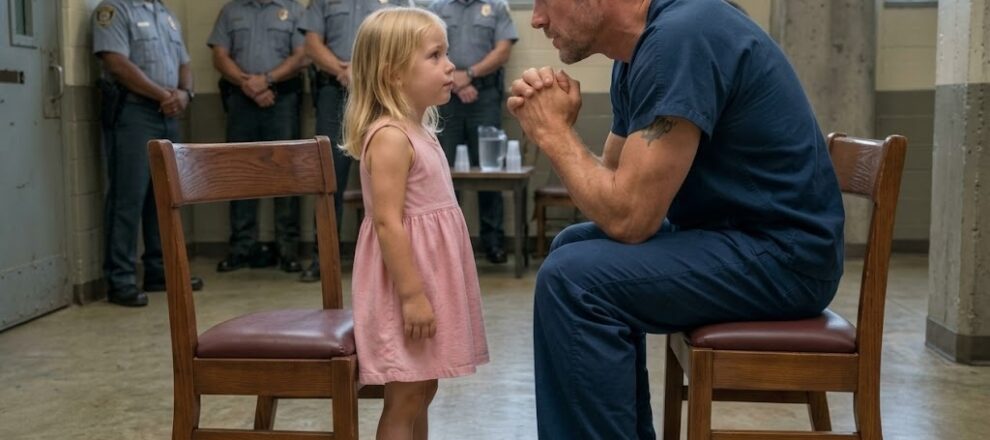
The guards stood on either side of the visitation room, hands resting near their belts, eyes trained on the shackled inmate and the little girl standing beside him.
Gavin Cole should have been weeping.
He should have been begging.
He should have been collapsing under the weight of the hours left between that room and the execution chamber.
Instead, he was smiling.
It was not a wide smile. Not the kind that belonged to a man who had been saved. It was smaller than that. Fragile. Almost broken.
But it was real.
And that was what unsettled them.
Warden Robert Mitchell watched from behind the glass, his arms folded across his chest. He had approved the visit against the advice of three administrators, two legal clerks, and the prison chaplain. Everyone had warned him that bringing a child into the facility on execution day was dangerous, unnecessary, and emotionally reckless.
Now he found himself staring through the reinforced window, wondering what an eight-year-old girl could possibly have said to make a condemned man look as though sunlight had entered the room.
Gavin lowered his forehead until it touched Chloe’s.
“My brave girl,” he whispered.
Chloe kept her small hands on his shoulders.
“I remembered, Daddy,” she said.
Gavin closed his eyes.
One of the guards shifted.
“What did she say?” the other murmured.
Mitchell pressed the intercom button.
“Officer Ruiz,” he said quietly. “Ask the inmate to repeat what the child told him.”
Inside the room, Officer Elena Ruiz stepped forward.
“Cole,” she said, not unkindly. “The warden wants to know what your daughter whispered.”
Gavin looked up.
The smile faded, but something stronger replaced it.
Hope.
“She said she remembered the song.”
Ruiz frowned.
“The song?”
Gavin nodded slowly, then looked back at Chloe.
“Tell them, baby.”
Chloe turned toward the glass. Her face was pale, but her voice came out clear.
“Mommy used to sing it when she was scared.”
The visitation room went still.
Gavin’s wife, Marissa Cole, had been dead for five years.
She was the murder victim.
The woman Gavin had been convicted of killing.
Officer Ruiz glanced toward the mirror, waiting for instruction.
Behind the glass, Warden Mitchell felt a cold pressure in his chest.
“What song, Chloe?” he asked through the speaker.
Chloe’s eyes moved toward the ceiling, as if searching through a memory half-buried by nightmares.
“‘Hush Now, Little Sparrow,’” she said. “Mommy sang it that night.”
Gavin inhaled sharply.
Mitchell leaned closer to the glass.
The night.
Not before.
Not days earlier.
That night.
The official case file stated Chloe had been asleep in her room during the murder. It stated she had heard shouting but saw nothing. It stated she was too young, too traumatized, and too confused to provide reliable testimony.
But there had always been a sealed psychological evaluation. Mitchell had never seen the full version. Few had.
The prosecutor had argued that exposing the child to more questioning would only harm her.
The judge had agreed.
And just like that, Chloe Cole had vanished from the case that decided whether her father lived or died.
Mitchell pressed the intercom again.
“Chloe,” he said, carefully softening his voice. “Do you remember something from that night?”
The social worker, Denise Hart, immediately stepped forward.
“Warden, she is not here to be questioned.”
“I understand,” Mitchell said. “But this man is scheduled to die tonight.”
Denise’s lips parted, then closed.
Gavin’s shackles clinked as he reached as far as the table allowed.
“Chloe,” he whispered, “you don’t have to say anything.”
But Chloe was no longer looking at her father.
She was looking at the men and women who had watched him prepare for death.
“I saw the man,” she said.
The words seemed too small to carry so much weight.
Officer Ruiz froze.
The other guard slowly turned his head.
Behind the glass, Mitchell stopped breathing.
Gavin whispered, “No…”
Chloe nodded.
“I saw him.”
Denise Hart touched the child’s shoulder.
“Honey, you told the therapists you didn’t see anyone.”
Chloe looked down.
“Because the man told me not to.”
The silence that followed was not empty.
It was crowded with every mistake, every assumption, every signed form, every ignored appeal.
Mitchell left the observation room so quickly his chair struck the wall behind him.
Inside the visitation room, Officer Ruiz’s radio crackled, but she did not answer.
Gavin stared at his daughter as if she were both miracle and wound.
“What man?” he asked.
Chloe swallowed.
“The man with the shiny ring.”
Gavin’s brow tightened.
“A ring?”
She nodded.
“It had a snake on it.”
The description hit Officer Ruiz first. Her face changed before she could stop it.
Mitchell entered the room.
“What is it?” he asked her.
Ruiz hesitated.
“Warden…”
“Say it.”
She lowered her voice.
“Detective Aaron Voss wears a ring like that.”
The name landed like a dropped weapon.
Aaron Voss.
The lead detective on the Marissa Cole murder case.
The man whose testimony had sealed Gavin’s conviction.
The man who had discovered the bloody shirt in Gavin’s truck.
The man who had told the court there was no sign of forced entry, no unidentified prints, no other suspect worth pursuing.
Mitchell turned back to Chloe.
“Did you know Detective Voss?”
Chloe shook her head.
“No.”
“Are you sure?”
“He came to our house before Mommy died,” she said.
Gavin’s face drained of color.
“No, he didn’t.”
Chloe looked at him.
“Yes, Daddy. He came when you were at work. Mommy made me go upstairs.”
The warden’s jaw tightened.
In the trial transcript, Marissa Cole had been described as a beloved elementary school teacher with no enemies, no criminal connections, and no known conflicts outside her marriage.
The prosecution had built its story around one idea: Gavin killed his wife during a violent argument.
But if Detective Voss had visited Marissa privately before her death, that idea no longer stood alone.
It leaned.
And something beneath it began to crack.
Mitchell pointed to Officer Ruiz.
“Call the attorney general’s office. Now.”
Ruiz blinked.
“Sir?”
“Now.”
Then he looked at the second guard.
“Get me the execution protocol director.”
The guard stepped out quickly.
Denise Hart pulled Chloe slightly behind her.
“Warden, this child needs protection.”
Mitchell nodded.
“Yes,” he said. “She does.”
Gavin looked from one adult to another, his eyes wild with fear.
“You can’t send her back,” he said. “If Voss finds out—”
“He won’t get near her,” Mitchell said.
But even as he said it, he understood the weakness of the promise.
Detective Aaron Voss was not a prison employee. He was not under Mitchell’s command. He was a decorated homicide detective, a man praised by judges, prosecutors, and newspapers.
A man who, if Chloe was telling the truth, had stood in a child’s bedroom doorway on the night her mother died.
The clock on the wall read 10:42 a.m.
Gavin Cole was scheduled to die at 6:00 p.m.
Seven hours and eighteen minutes remained.
By noon, the prison had changed shape.
Executions were machines. Every person had a role. Every hallway served a function. Every minute moved toward the final room.
But now the machine stuttered.
Phones rang in offices that were usually quiet. Legal aides pulled old files from locked cabinets. The chaplain waited in a corridor with his Bible unopened in his hands. The medical team was told to remain on standby, then told nothing else.
Gavin was returned to Cell 18, but he did not sit.
He paced as far as the small space allowed, chains scraping at his ankles.
Across from him, Warden Mitchell stood with a folder pressed under one arm.
“I requested an emergency stay,” Mitchell said.
Gavin turned.
“And?”
“The governor’s counsel wants corroboration.”
Gavin laughed once, bitterly.
“My eight-year-old daughter remembers the killer, and they want paperwork?”
“They want something that can survive a judge asking why this came out on execution day.”
“Because no one listened before execution day.”
Mitchell did not argue.
There was nothing to argue with.
Gavin gripped the bars.
“Where is Chloe?”
“With Ms. Hart. In a secure interview room.”
“Is she scared?”
“Yes.”
Gavin closed his eyes.
Mitchell’s voice softened.
“But she asked for crayons.”
Gavin let out a breath that almost became a sob.
“She always does that when she’s trying not to cry.”
For a moment, they were not warden and inmate.
They were two men standing on opposite sides of iron, both understanding that innocence, once buried, did not rise gently. It tore through everything above it.
Mitchell opened the folder.
“There’s something else.”
Gavin looked at him.
“I had my clerk pull the evidence logs from your trial. The original inventory listed three items collected from Chloe’s bedroom.”
Gavin frowned.
“Her bedroom? They told me nothing was taken from there.”
“That is what the final report says.”
“What were the items?”
Mitchell read from the page.
“One stuffed rabbit. One pink blanket. One cassette tape.”
Gavin stared at him.
“Cassette tape?”
“Do you know what that could be?”
Gavin’s fingers tightened around the bars.
Marissa had kept an old tape recorder in Chloe’s room.
She used it when Chloe had trouble sleeping. She would record lullabies, bedtime stories, little messages for nights when Gavin worked late and Marissa had school events.
Gavin’s voice dropped.
“The song.”
Mitchell looked up.
“She recorded songs for Chloe?”
“Yes. Sometimes the recorder stayed on by accident.”
Neither man spoke.
The thought formed between them at the same time.
If the recorder had been running that night…
Mitchell snapped the folder shut.
“I’ll find the tape.”
But the moment he said it, his expression darkened.
“What?” Gavin asked.
“The evidence log says it was transferred to Detective Voss.”
Gavin’s face hardened.
“Then it’s gone.”
Mitchell did not answer.
Because he feared the same thing.
At 1:15 p.m., in a small interview room inside the prison administration wing, Chloe sat at a metal table with a box of crayons and a paper cup of apple juice.
Denise Hart sat beside her.
Across from them was a woman named Evelyn Price, an investigator from the state attorney general’s office who had driven ninety miles after receiving Mitchell’s call.
Evelyn had handled false confessions, tampered evidence, missing lab reports, and police misconduct cases. She had heard adults lie with tears in their eyes and criminals tell the truth while smirking.
But children were different.
Children rarely told stories in straight lines.
They offered fragments.
Colors.
Sounds.
The shape of fear.
Evelyn placed a small recorder on the table.
“Chloe, I’m not here to get anyone in trouble,” she said. “I just need to understand what you remember.”
Chloe colored the roof of a house red.
“My mommy died.”
“I know.”
“Everyone said Daddy did it.”
“What do you remember?”
Chloe pressed the crayon harder.
“I woke up because Mommy was singing.”
“The sparrow song?”
Chloe nodded.
“She only sang that when she was crying.”
Denise looked down.
Evelyn kept her voice calm.
“What happened after you woke up?”
“I went to the stairs.”
“And what did you see?”
Chloe’s crayon stopped moving.
“Mommy was on the floor.”
The room seemed to shrink.
“Was your father there?”
“No.”
“Are you sure?”
Chloe nodded.
“Daddy wasn’t home yet. Mommy kept saying, ‘Please, Aaron. Please don’t.’”
Evelyn Price slowly lifted her eyes.
Denise covered her mouth.
“What name did she say?” Evelyn asked.
“Aaron.”
The recorder captured the word cleanly.
Evelyn leaned forward.
“And the man?”
“He was mad.”
“What did he look like?”
Chloe reached for a black crayon.
“He had dark hair. He smelled like smoke. He had a ring.”
She drew a small circle on the paper.
Then she added a twisting line through it.
“A snake.”
Evelyn looked at the drawing.
“Did he see you?”
Chloe nodded.
“He came upstairs after.”
Denise’s hand tightened around the edge of the table.
“He came into your room?”
“Yes.”
“What did he say?”
Chloe’s voice became smaller.
“He said if I told, Daddy would die faster. And then I would disappear too.”
Evelyn sat back slowly.
The legal world outside that room required signatures, warrants, chain of custody, procedural standards, sworn affidavits, and admissible evidence.
But in that moment, all she could see was a little girl carrying five years of terror in her chest.
“What happened next, Chloe?”
“Daddy came home. He yelled Mommy’s name. Then the police came.”
“Did you see the man again?”
Chloe nodded.
“At the courthouse.”
Evelyn stiffened.
“When?”
“When they made me talk to the lady.”
“The psychologist?”
“I think so.”
“What happened?”
“He was in the hallway. He looked at me and touched his ring.”
Chloe put down the crayon.
“So I said I didn’t remember.”
Evelyn Price rose from her chair so quickly it scraped the floor.
“I need a phone,” she said.
By 2:00 p.m., the case of State of Texas v. Gavin Cole was no longer resting quietly in storage.
It was bleeding through every sealed drawer that had held it.
Evelyn Price obtained the original child services notes from Chloe’s first interviews. One line had been crossed out with black marker but was still faintly visible when held against a lamp.
Child stated: “The man told Mommy not to tell Gavin.”
Below it, in another handwriting, someone had written:
Unreliable. Trauma response. Exclude from summary.
Evelyn requested the psychologist’s full report.
It had been sealed.
Then amended.
Then replaced.
The amended version omitted Chloe’s mention of “Aaron.”
The original version, buried in an archived digital folder under a misspelled case number, did not.
At 2:47 p.m., Evelyn called Warden Mitchell.
“I have enough to request an emergency judicial review,” she said.
“Enough to stop the execution?”
“I don’t know.”
Mitchell stared through the narrow window of his office toward the prison yard.
“Find more.”
“I’m trying.”
“Try faster.”
He hung up and immediately called the governor’s counsel again.
This time, he did not ask politely.
“You execute him tonight,” Mitchell said, “and tomorrow the entire state may learn you killed a man after a witness identified someone else.”
The voice on the other end stayed measured.
“Warden, be careful.”
“I am being careful. That’s why I’m calling.”
At 3:30 p.m., Detective Aaron Voss was found sitting at his desk in the county homicide division, drinking coffee from a chipped blue mug.
He was fifty-one, broad-shouldered, and handsome in the hard, weathered way that juries trusted. He had a silver streak in his hair, a calm voice, and the kind of reputation that made younger detectives lower their own voices when he entered a room.
When two investigators from internal affairs approached him, he smiled.
“Something I can help with?”
They asked about the Marissa Cole case.
His smile did not vanish.
It simply stopped moving.
“That case is closed,” he said.
“New information came in.”
“From whom?”
“A witness.”
Voss set down his mug.
“What witness?”
They did not answer.
For the first time, his eyes sharpened.
“Cole’s execution is today.”
“Yes.”
“And now someone remembers something?”
“So it seems.”
Voss leaned back in his chair.
“Let me guess. The daughter.”
Neither investigator spoke.
Voss gave a quiet laugh.
“That child was unstable. Everyone knew it.”
One investigator opened a folder.
“We’re looking for a cassette tape collected from her bedroom.”
Voss looked at the folder.
Then at the investigator.
“I don’t know anything about a cassette tape.”
“The chain of custody says it was transferred to you.”
“I handled hundreds of items.”
“From a capital murder scene?”
Voss’s voice cooled.
“Watch your tone.”
The investigator slid a copy of the evidence form across the desk.
Voss glanced at it.
His expression remained controlled.
But his right hand moved under the desk.
The second investigator noticed.
“Detective.”
Voss stood.
“I need to make a call.”
“No, you need to sit down.”
The room around them seemed to pause.
Detectives at nearby desks stopped typing.
Voss smiled again, but this time it did not reach his eyes.
“You boys have no idea what you’re walking into.”
Then the lights went out.
For two seconds, the homicide division fell into darkness.
Someone cursed.
A chair tipped over.
By the time emergency lights flickered red across the room, Aaron Voss was gone.
At 4:05 p.m., Warden Mitchell received the call.
He listened without speaking.
Then he slowly turned toward Gavin’s cell.
Gavin stood when he saw him.
“What happened?”
Mitchell’s face told him enough.
“What happened?” Gavin repeated.
“Voss ran.”
Gavin gripped the bars.
“Then it’s true.”
Mitchell did not say yes.
He did not need to.
Down the corridor, guards moved with new urgency. Radios crackled. Doors slammed. Somewhere inside the prison, the machinery of death waited, confused by the machinery of doubt.
At 4:22 p.m., the state filed an emergency motion for a temporary stay.
At 4:39 p.m., the victim’s family was notified.
Marissa’s brother, Daniel, who had spent five years calling Gavin a monster, refused to believe it.
“No,” he said over the phone. “No, you don’t get to do this now. Not today.”
Evelyn Price spoke carefully.
“Mr. Hayes, your sister may have known Detective Voss.”
“That’s impossible.”
“We have reason to believe he visited her before her death.”
Daniel went quiet.
“What did you say?”
Evelyn waited.
Daniel’s breathing changed.
“Mr. Hayes?”
“There was a man,” he said slowly.
“What man?”
“Marissa called me two days before she died. She was upset. She said she’d made a mistake trusting someone.”
“Did she say who?”
“No. I asked if it was Gavin. She said, ‘No, Gavin can never know.’”
Evelyn closed her eyes.
Another crack.
Wider this time.
“Why didn’t you tell anyone?”
“I did,” Daniel said. His voice broke. “I told Detective Voss.”
At 5:10 p.m., the execution chamber was prepared.
No one had given the order to cancel.
No one had given the order to proceed.
The witnesses had already begun arriving. Some believed they were there to see justice. Others came because the law had invited them to watch a sentence carried out in their names.
Gavin sat alone in a holding cell adjacent to the chamber.
His hands were cuffed in front of him.
A guard offered him water.
He declined.
On the other side of the prison, Chloe sat with Denise Hart, drawing the same image over and over.
A house.
A stairway.
A man with a snake ring.
And, in the upstairs window, a little girl with no mouth.
At 5:26 p.m., Evelyn Price found the tape.
Not in evidence storage.
Not in Detective Voss’s home.
Not in his office.
It was in the basement archive of the county courthouse, inside a box labeled for an unrelated burglary case from the same year.
The cassette had no official tag.
Only a strip of yellowing tape across the front with Chloe’s name written in Marissa’s handwriting.
Chloe — bedtime songs.
Evelyn stared at it as if it were alive.
The technician beside her said, “This thing may be damaged.”
“Play it.”
“It could snap.”
“Copy it, then play it.”
The first transfer failed.
The second produced static.
The third gave them a faint melody.
A woman’s voice.
Soft.
Shaking.
“Hush now, little sparrow…”
Evelyn’s heart began to pound.
The song continued for twenty seconds.
Then a thud.
A gasp.
A man’s voice in the background.
Low. Angry.
“You should have left it alone, Marissa.”
The technician looked at Evelyn.
She raised one finger, ordering silence.
Marissa’s voice came next.
“Aaron, please. Gavin doesn’t know anything.”
The man replied, clearer this time.
“He will when I’m finished.”
Then came a sound Evelyn would never forget.
A child’s bedroom door creaking open.
Small footsteps.
Marissa screaming, “Chloe, run!”
The tape dissolved into crashing noise.
Then another voice, closer to the recorder now.
The same man.
Calm.
Almost gentle.
“Go back to bed, sweetheart.”
A pause.
Then:
“Not one word.”
The tape cut to static.
Evelyn Price looked at the clock.
5:41 p.m.
Nineteen minutes.
She grabbed her phone.
The emergency judge was already on the line when she reached the courthouse steps, running with the copied audio file clutched in her hand like a match in a storm.
At 5:52 p.m., Warden Mitchell stood outside the execution chamber with two phones pressed against his desk.
One connected him to the governor’s counsel.
The other connected him to the emergency judge.
Gavin had already been moved.
He lay strapped to the gurney, leather restraints across his chest, arms, wrists, thighs, and ankles.
The IV team had not inserted the lines yet.
A chaplain stood near the wall, lips moving silently.
Behind the glass, witnesses shifted in their seats.
Daniel Hayes was there, eyes red, jaw clenched, hatred and confusion tearing at each other inside him.
Chloe was not allowed near the chamber.
But Gavin could almost feel her somewhere in the building.
He stared at the ceiling.
For five years, everyone had asked him to confess.
Police.
Prosecutors.
Reporters.
Strangers.
Even grief had seemed to accuse him.
But he had never confessed because the truth was the only thing he had left to give his daughter.
The door opened.
Warden Mitchell entered.
Every eye moved to him.
The execution team waited.
Mitchell’s face was pale.
He held a phone against his ear.
“Yes, Your Honor,” he said.
A pause.
Then his shoulders lowered.
He looked at Gavin.
“Remove the restraints.”
No one moved.
Mitchell’s voice thundered through the chamber.
“Remove them now.”
A murmur rose behind the glass.
The chaplain closed his eyes.
Gavin turned his head slowly.
“What does that mean?”
Mitchell approached the gurney.
“It means you’re not dying today.”
Gavin stared at him.
His lips trembled, but no sound came out.
At 5:57 p.m., three minutes before the scheduled execution, the State of Texas formally suspended the sentence of Gavin Cole pending emergency review.
At 6:00 p.m., the clock struck the hour he was supposed to die.
Instead of poison entering his veins, a guard unlocked the strap across his chest.
Gavin sat up slowly, as though gravity itself had changed.
Behind the glass, Daniel Hayes stood.
For five years, he had pictured this moment differently. He had imagined satisfaction. Closure. A final breath answering for his sister’s last one.
Instead, he watched the condemned man lower his face into his hands and weep like someone returning from the edge of a grave.
Daniel turned away.
Not because he hated Gavin.
Because he was no longer certain he had the right to.
By midnight, the tape had been authenticated enough for an emergency stay to hold.
By morning, the story had reached every major newsroom in the state.
Death Row Father Spared Minutes Before Execution.
Child Witness Identifies Lead Detective.
Missing Tape May Clear Convicted Man.
The public wanted answers.
The governor demanded a briefing.
The district attorney held a press conference and said the justice system worked because it corrected itself.
Evelyn Price, watching from the back of the room, nearly laughed.
Corrected itself?
No.
A child had carried the truth alone until the adults ran out of time to ignore it.
Gavin was moved out of death watch and into protective custody.
He had not been exonerated.
Not yet.
The conviction still stood, wounded but alive.
And wounded things could be dangerous.
At 9:30 a.m., Warden Mitchell brought Chloe to see him again.
This time, there was no execution clock on the wall.
No final meal tray.
No chaplain waiting nearby.
Only a father and daughter separated by five years of stolen life.
Chloe entered the room holding the stuffed rabbit from the evidence box.
Its fur was faded. One ear bent permanently to the side.
Gavin saw it and covered his mouth.
“I thought it was gone,” he said.
Chloe placed it on the table.
“Mommy kept the tape inside the zipper,” she whispered.
Gavin looked at the rabbit.
Then at Mitchell.
The warden frowned.
“The cassette we found was in the courthouse archive.”
Chloe shook her head.
“That was the copy.”
Evelyn Price, standing near the door, went still.
“What do you mean, sweetheart?”
Chloe turned the rabbit over.
With small fingers, she opened a hidden seam along its back.
Inside was a thin plastic memory card wrapped in tissue.
Everyone in the room stared.
Gavin whispered, “Marissa…”
Chloe looked up at him.
“Mommy told me if the bad man came back, I should keep Sparrow safe.”
Evelyn stepped forward slowly.
“Chloe, who gave this rabbit back to you?”
“The lady from the courthouse,” Chloe said. “A long time ago.”
“What lady?”
Chloe shrugged.
“She had red glasses.”
Evelyn and Mitchell exchanged a glance.
No one in the official evidence chain had red glasses.
Evelyn took the memory card with gloved hands.
Within an hour, technicians recovered the first file.
It was not audio.
It was video.
Grainy.
Dim.
Recorded from a small camera hidden somewhere inside the Cole living room.
The timestamp was from the week before Marissa’s murder.
On the screen, Marissa stood near the fireplace, arms folded tightly.
Across from her stood Detective Aaron Voss.
And beside him…
Evelyn stopped the playback.
“No,” she whispered.
Warden Mitchell leaned closer.
Gavin, watching through the glass from the interview room, felt his blood turn cold.
Because Aaron Voss was not alone.
The second man in the video was older.
Better dressed.
Familiar to anyone who had followed Gavin’s trial.
It was the prosecutor who had asked the jury to sentence him to death.
District Attorney Samuel Creed.
On the recording, Creed stepped toward Marissa Cole and placed a folder on her coffee table.
His voice came through the speakers, calm and unmistakable.
“You should have taken the money, Marissa.”
Marissa shook her head.
“I won’t lie for you.”
Voss moved closer.
Creed sighed.
“Then you’re leaving us no choice.”
The video ended.
No one spoke.
The case had not cracked.
It had opened into something deeper.
Something organized.
Something that had needed Marissa silent, Gavin blamed, and Chloe afraid.
Evelyn Price looked through the glass at Gavin Cole.
His conviction was collapsing.
But now everyone understood the terrifying truth.
Marissa Cole had not been killed because her husband was angry.
She had been killed because she knew something powerful men were willing to bury.
And somewhere outside the prison walls, Aaron Voss was still missing.
At that exact moment, fifty miles away, Detective Voss stood in a motel bathroom, shaving off his mustache with a disposable razor.
A burner phone vibrated on the sink.
He answered without speaking.
A distorted voice came through.
“The child had the backup.”
Voss stared at himself in the mirror.
Blood from a small shaving cut slid down his chin.
“I can fix it,” he said.
“No,” the voice replied. “You had five years to fix it.”
Voss’s eyes narrowed.
“What do you want me to do?”
There was a pause.
Then the voice said, “Bring me Chloe Cole.”
Voss looked toward the motel room window, where the morning sun glared through the curtains like a warning.
Then he smiled.
PART 3
By noon, the Huntsville Unit no longer felt like a prison preparing for an execution.
It felt like a building holding its breath.
The execution chamber had been cleaned, tested, and sealed. The gurney straps lay waiting beneath fluorescent lights. The witnesses had already been notified. The chemicals had been prepared.
But now every clock in the prison seemed to tick differently.
Not toward death.
Toward discovery.
Warden Robert Mitchell stood in his office with the phone pressed tightly against his ear, his other hand gripping the edge of his desk until his knuckles went white.
On the speakerphone, Assistant Attorney General Denise Rourke spoke in a voice so controlled it sounded almost unreal.
“Warden, the execution has been temporarily suspended by emergency order. Gavin Cole is not to be moved. No one enters his cell except your most trusted officers.”
Mitchell stared through the glass window into the hallway where guards whispered in nervous clusters.
“Who fabricated the evidence?” he asked.
There was a pause.
Then Denise said, “Former lead investigator Marcus Vale.”
Mitchell’s blood ran cold.
Detective Marcus Vale had been the man who put Gavin Cole on death row. His testimony had sealed the case. His confidence in court had crushed every doubt.
“He’s still active?” Mitchell asked.
“Worse,” Denise replied. “He’s now Deputy Director of Criminal Investigations.”
For a moment, Mitchell said nothing.
Then he looked toward the visitation room, where Gavin Cole sat with his eight-year-old daughter still holding his shackled hand.
A man minutes from death had just become the most dangerous witness in Texas.
Inside the room, Gavin had not stopped looking at Chloe.
Her small fingers rested on his palm, tracing the lines as if trying to memorize the shape of him before the world changed again.
“Daddy,” she whispered, “are they still going to hurt you?”
Gavin swallowed hard.
He wanted to promise her no.
He wanted to gather her into his arms and tell her monsters always lost, that truth always arrived in time, that fathers came home when little girls were brave.
But five years on death row had taught him that justice was not a river.
Sometimes it was a locked door.
And sometimes it took a child to find the key.
“I don’t know, baby,” he said softly. “But you did something very brave.”
Chloe looked down.
“Mommy told me to wait until the last day.”
Gavin froze.
“What do you mean?”
“She said bad people would watch us. She said if I told too early, they would make it disappear.”
The social worker, Mara Benton, slowly raised a hand to her mouth.
“What else did your mother tell you?” Mitchell asked gently.
Chloe looked at him with eyes too old for eight years.
“She said Mr. Vale wasn’t a policeman anymore.”
Everyone in the room went still.
Gavin leaned forward.
“What did she mean?”
Chloe’s voice dropped.
“She said he belonged to someone else.”
At that exact moment, a siren wailed outside the prison walls.
Mitchell turned sharply.
An officer burst through the door.
“Warden, we have a problem.”
“What now?”
The officer’s face was pale.
“Deputy Director Marcus Vale just arrived at the front gate.”
The air changed.
Gavin rose so abruptly his chains snapped tight against the table.
“No,” he said. “Keep him away from my daughter.”
Mitchell straightened.
“Lock down this unit.”
“Sir—”
“Now.”
Within seconds, alarms echoed through the corridors. Heavy doors slammed shut one after another. Boots thundered against concrete floors.
At the main entrance, Marcus Vale stepped from a black government SUV wearing a charcoal suit, polished shoes, and the calm expression of a man accustomed to being obeyed.
Rain had begun to fall, tapping against the roof of the gatehouse like impatient fingers.
“I’m here to take custody of evidence related to the Gavin Cole matter,” Vale said, flashing his badge.
The guard at the gate hesitated.
“Sir, we were told no outside personnel—”
Vale smiled.
It was not warmth.
It was warning.
“Do you understand who I am?”
Before the guard could answer, Mitchell’s voice crackled over the intercom.
“Deputy Director Vale, you are not authorized to enter this facility.”
Vale slowly looked up toward the security camera.
For the first time, his smile faded.
“Warden Mitchell,” he said, “you are interfering with a state investigation.”
Mitchell stood inside the control room watching him on the monitor.
“No,” he replied. “I’m protecting one.”
Vale leaned closer to the camera.
“You have no idea what you’re stepping into.”
Mitchell’s jaw tightened.
“I’m beginning to.”
Then he gave the order.
“Remove him from the gate.”
Two armed officers approached Vale.
He did not resist.
But before he turned away, he looked directly into the camera and spoke three words that chilled everyone listening.
“Ask the girl.”
Back in the visitation room, Chloe squeezed Gavin’s hand so tightly her small fingers trembled.
Gavin looked at her.
“Chloe?”
She began to cry for the first time.
Not loudly.
Not like a child throwing fear into the room.
Her tears slipped silently down her cheeks.
“Mommy made me hide,” she whispered. “The night she died.”
Gavin’s breath caught.
“You were there?”
Chloe nodded.
The room tilted around him.
For five years, the official report had said Chloe was asleep at a neighbor’s house.
For five years, Gavin had believed his daughter had been spared the horror.
For five years, the truth had been buried inside the only witness no one had thought to ask.
Chloe shut her eyes.
“I saw Mr. Vale.”
And with those four words, the case against Gavin Cole cracked open like glass under a hammer.
PART 4 — The Woman Who Knew Too Much
Five years earlier, Emma Cole had been afraid before she understood why.
At first, it was little things.
A client who canceled abruptly.
A black sedan parked twice on their street.
A phone call that ended the moment Gavin answered.
Emma was a forensic accountant, the kind of woman who could smell a lie hidden inside a column of numbers. She had built her career following money through shell companies, fake charities, offshore accounts, and political campaigns that looked clean only from a distance.
She was not famous.
She was not powerful.
But she was meticulous.
And that made her dangerous.
Three weeks before her death, Emma had discovered that elderly widow Margaret Harper had been unknowingly used as the owner of several accounts moving millions of dollars through a charity called Bright Harbor Foundation.
On paper, Bright Harbor helped abused children.
In reality, it moved money for judges, contractors, law enforcement officials, and campaign donors.
Margaret Harper had wanted out.
So she hired Emma.
That decision killed them both.
On the night of the murder, rain slammed against the Cole house windows. Gavin had left to repair a broken water line at his auto shop. Chloe, then only three, had been playing with a stuffed rabbit beneath the kitchen table while Emma spoke hurriedly into her phone.
“No,” Emma whispered. “I copied everything. If Vale comes here, I’m going to the Attorney General.”
Chloe remembered her mother’s hand shaking.
She remembered the silver key.
She remembered the red ribbon.
Most of all, she remembered the knock.
Three heavy strikes.
Emma had grabbed Chloe and pulled her into the hallway closet.
“Listen to Mommy,” she whispered, kneeling so their foreheads touched. “You are going to play the quiet game. No matter what you hear, no matter who comes in, you do not move.”
Chloe clutched her rabbit.
“Mommy, I’m scared.”
Emma kissed her hair.
“I know, baby. But you are brave. Braver than anyone.”
Then she slipped the key into Chloe’s tiny dress pocket.
“If Daddy is ever going to be hurt, give him this.”
“Why?”
Emma’s eyes filled with tears.
“Because truth sometimes needs a hiding place.”
The front door opened.
Emma stood.
Chloe watched through a narrow crack in the closet door.
Two men entered.
One was Marcus Vale.
The other wore black gloves and carried a small leather folder.
Chloe never saw his face clearly.
But she saw his ring.
A gold ring shaped like a lion’s head.
Vale’s voice was low.
“You should have stayed with numbers, Emma.”
Emma backed toward the kitchen.
“Margaret Harper gave me everything. Names. Payments. Dates. Judges. Officers.”
Vale sighed.
“You don’t understand. People like you think evidence matters.”
“It does.”
“No,” Vale said. “Power matters.”
Then the man with the lion ring struck Emma.
Chloe buried her face in her rabbit to keep from screaming.
Hours later, Gavin came home and found Margaret Harper dead in their detached office beside the garage, Emma bleeding in the kitchen, and police already pulling into the driveway.
Marcus Vale had arrived first.
Too fast.
Too prepared.
The weapon was placed in Gavin’s stunned hands before he understood what was happening.
“Secure him,” Vale shouted.
“I didn’t do this!” Gavin cried. “My wife needs help!”
But Emma Cole died before sunrise.
Margaret Harper was declared the murder victim in the trial.
Emma’s death was treated as collateral violence committed during Gavin’s “rage.”
The story was simple.
Too simple.
And simple stories were easy for juries to believe.
Now, inside the prison, Chloe told the truth in broken pieces.
Mara Benton held a tissue to her eyes. One guard turned away completely.
Gavin did not move.
Every sentence cut him open.
His wife had not only known she might die.
She had prepared their daughter to carry the truth through years of silence.
Mitchell ordered the entire statement recorded.
By 2:00 p.m., the contents of Emma’s locked case had reached the Attorney General’s office under armed escort.
By 2:17 p.m., the first hard drive was decrypted.
By 2:31 p.m., investigators found video files.
One was labeled:
HARPER MEETING — IF I DIE, PLAY FIRST.
Denise Rourke clicked it open.
On the screen appeared Margaret Harper, seventy-one years old, frail but furious, seated across from Emma Cole.
“I don’t want protection,” Margaret said. “I want them exposed.”
Emma’s voice came from off camera.
“Say the names clearly.”
Margaret leaned forward.
“Marcus Vale. Judge Peter Langford. District Attorney Carl Reeve. And the man they all answer to…”
She looked toward the camera, terrified.
“Senator Elliot Crane.”
Denise Rourke stopped breathing.
Senator Crane was three months away from announcing a campaign for governor.
He was beloved.
Untouchable.
Smiling from billboards across the state with slogans about justice, families, and faith.
Denise replayed the video.
Margaret Harper’s voice trembled through the speakers.
“They used my name. My accounts. My dead husband’s charity. When I found out, they said no one would believe a confused old woman.”
Then came Emma’s voice.
“I believe you.”
Margaret began to cry.
“That’s why you’re in danger too.”
Denise closed her laptop slowly.
Outside her office, phones were ringing nonstop.
Inside, she understood the terrifying truth.
Gavin Cole had not been convicted because the system made a mistake.
He had been convicted because the system had been used as a weapon.
PART 5 — The Execution That Became a Trap
At 4:00 p.m., the governor’s office released a brief statement.
The execution of Gavin Cole has been suspended pending emergency review.
Across Texas, televisions lit up with breaking news banners.
Outside Huntsville Unit, reporters gathered in the rain, shouting questions over barricades.
Inside the prison, Gavin sat alone in a holding cell, no longer scheduled to die but not yet free enough to breathe.
Freedom, he had learned, did not arrive all at once.
Sometimes it came like sunrise through bars.
Slow.
Unbelievable.
Painful to look at.
Warden Mitchell entered carrying two cups of coffee.
“You probably don’t want prison coffee on the day you were supposed to die,” he said.
Gavin gave a tired laugh.
“I didn’t expect to want anything today.”
Mitchell slid the cup through the slot.
“They’re moving fast.”
“Fast?” Gavin looked at him. “They had five years.”
Mitchell lowered his gaze.
“You’re right.”
Gavin stared at the steam rising from the cup.
“My wife died with the truth in her hands. My daughter carried it alone. And I was lying ten feet from a death chamber before anyone cared.”
Mitchell did not defend the system.
He had spent too long inside it to insult Gavin with excuses.
Instead he said, “I’m sorry.”
Gavin looked up.
For five years, he had heard prosecutors call him a monster.
He had heard reporters call him cold-blooded.
He had heard strangers call for his death.
But no official had ever looked him in the eye and said those two words.
His face tightened.
Then he turned away.
Meanwhile, Denise Rourke set a trap.
She knew Marcus Vale would not run immediately. Men like him survived by controlling the story. He would try to reach the evidence, intimidate witnesses, destroy what remained, and activate everyone who owed him favors.
So she leaked one false detail to a single compromised channel:
The original hard drive had not yet been copied.
Within an hour, someone attempted to access the evidence vault.
The security camera captured him clearly.
Assistant District Attorney Lionel Pierce.
The same prosecutor who had argued Gavin’s death sentence.
Pierce entered using emergency credentials, walked directly to the Harper-Cole evidence box, and removed a sealed envelope.
He was arrested before he reached the elevator.
At first, he said nothing.
Then Denise placed a tablet in front of him and played the video of Margaret Harper naming names.
Pierce’s face collapsed.
“You don’t understand,” he whispered. “Crane owns half the courts in this state.”
Denise leaned in.
“Then help me take back the other half.”
Pierce laughed bitterly.
“You think this ends with Vale? Vale is muscle. Langford is cover. Reeve is cleanup.”
“And Crane?”
Pierce’s eyes filled with fear.
“Crane is the reason bodies become paperwork.”
Before Denise could ask another question, her phone buzzed.
Unknown number.
She answered.
A distorted voice spoke.
“Release Gavin Cole and the girl disappears.”
Denise stood so suddenly her chair struck the wall.
“Who is this?”
The line went dead.
At Huntsville, alarms sounded again.
Mitchell’s radio crackled.
“Warden, we have an unauthorized vehicle near the east service road.”
Mitchell ran.
Rain pounded the prison yard. Floodlights swept across fences and razor wire. In the distance, a gray van idled beside a maintenance gate that should have been locked.
Two officers approached with weapons drawn.
The van door slid open.
Empty.
Except for a child’s blue hair ribbon lying on the floor.
Mitchell’s stomach dropped.
“Mara,” he shouted into the radio. “Where is Chloe?”
Static.
Then Mara Benton’s voice, panicked.
“She’s with me. We’re in the secure waiting room. Why?”
Mitchell closed his eyes in relief.
Then another voice cut into the radio.
Not Mara’s.
Marcus Vale.
“Are you sure?”
The waiting room door slammed open.
Mara screamed.
Chloe ducked beneath a chair as two men in maintenance uniforms rushed in.
But before they could reach her, Gavin Cole moved faster than anyone expected.
Mitchell had allowed him, against regulation, to be escorted nearby for a second goodbye. His shackles had been loosened but not removed.
When he heard Mara scream, something ancient and unstoppable rose inside him.
He tore free from the stunned officer beside him and threw himself into the first attacker.
Both men crashed into the wall.
The second lunged toward Chloe.
Gavin swung the chain between his cuffs and caught the man across the throat, sending him sprawling.
“Run, Chloe!” he shouted.
But Chloe did not run away.
She ran to him.
Guards flooded the room seconds later, weapons drawn.
The attackers were pinned.
One of them spat blood onto the floor and laughed.
“You’re still dead, Cole.”
Gavin stood over him, chest heaving, his daughter clinging to his leg.
“No,” Gavin said.
His voice was low.
Certain.
“For the first time in five years, I’m alive.”
PART 6 — The Lion Ring
The failed kidnapping changed everything.
By nightfall, Senator Elliot Crane’s smiling face vanished from campaign websites. His office released a statement calling the allegations “politically motivated fiction,” but no one believed confidence that arrived before evidence.
The arrested attackers refused to talk.
Until investigators removed one man’s glove.
On his right hand was a tattoo of a lion’s head.
Chloe saw the photograph and went completely still.
“That’s the same lion,” she whispered. “Like the ring.”
Denise Rourke opened the recovered files again, searching every folder Emma had saved.
At 11:48 p.m., she found it.
A photograph taken through a restaurant window.
Marcus Vale sitting at a private table.
District Attorney Carl Reeve beside him.
Judge Peter Langford pouring wine.
And Senator Crane at the head of the table, laughing.
His right hand rested on the white tablecloth.
On his finger gleamed a gold lion-head ring.
Denise stared at it.
Then she noticed something else in the picture.
A little boy, maybe six years old, sitting at another table in the background, looking directly toward Emma’s camera.
The file name read:
WITNESS — FIND HIM.
Denise zoomed in.
The restaurant logo appeared on a napkin.
The Blue Lantern.
Five years ago, Houston.
She sent agents immediately.
The Blue Lantern had closed two years earlier, but the owner was still alive. He remembered Emma Cole.
“She came in scared,” he told investigators. “Said powerful men were meeting there. Asked if my cameras worked.”
“Did they?”
He hesitated.
“Officially? No. I told the police the system was broken.”
“Unofficially?”
The old man walked to a safe behind his pantry and removed a dusty flash drive.
“I had a son,” he said quietly. “Crane’s people threatened him. I stayed quiet because I was a coward.”
Denise took the drive.
The old man looked at her with wet eyes.
“Is it too late to stop being one?”
The footage was grainy.
But it was enough.
It showed Crane, Vale, Reeve, and Judge Langford discussing Margaret Harper.
It showed Crane tapping his lion ring against a glass.
It captured his words clearly.
“If the widow talks, bury the accountant beside her and give the husband a motive.”
No one in the evidence room spoke.
Then the footage continued.
Vale asked, “And the child?”
Crane replied, “Children forget.”
Denise felt the blood leave her face.
Children forget.
But Chloe had not forgotten.
She had survived.
She had carried the truth like a tiny flame through five years of darkness.
By dawn, arrest warrants were prepared.
But before they could be served, Senator Crane made one final move.
He walked into a press conference surrounded by flags, lawyers, and cameras.
“My fellow Texans,” he began, “a dangerous lie is being spread by desperate people attempting to free a convicted murderer.”
Reporters shouted questions.
Crane lifted his hand.
The lion ring flashed beneath the lights.
Then a voice from the back of the room said, “Take off your ring.”
The room fell silent.
Gavin Cole stood between two federal marshals.
Beside him stood Chloe.
Denise had arranged it without warning the press. Gavin was still technically in custody, but the emergency hearing had allowed his presence as a material witness.
Crane’s face tightened.
“This is outrageous.”
Chloe stepped forward.
The microphones lowered toward her.
Her voice was small.
But clear.
“You were in my house.”
A murmur rolled through the room.
Crane smiled coldly.
“Sweetheart, you were three years old. You don’t know what you saw.”
Chloe reached into her pocket and pulled out her stuffed rabbit.
Old.
Patched.
Faded.
The same rabbit she had held in the closet the night her mother died.
“My mommy gave this to me,” she said.
Then she turned it over.
A seam along the back had been restitched.
Denise gently opened it.
Inside was a tiny memory card wrapped in plastic.
Gavin stared.
“Chloe,” he whispered. “Did you know that was there?”
She shook her head.
“Mommy said Mr. Rabbit had a secret heart.”
Denise inserted the card into a laptop.
The video appeared.
Emma Cole’s face filled the screen.
She was sitting in Chloe’s bedroom, whispering urgently.
“If you are watching this, then I am dead, and Gavin has been blamed.”
Behind Emma, the bedroom door creaked.
Voices shouted downstairs.
Emma’s eyes filled with terror.
She leaned closer.
“Gavin didn’t kill Margaret Harper. Marcus Vale planted the weapon. Senator Elliot Crane ordered everything. The proof is in the storage unit, but this is for Chloe.”
Emma’s voice broke.
“My sweet girl, I am so sorry I had to ask you to be brave.”
In the press room, Chloe began to sob.
Gavin dropped to his knees and wrapped his arms around her.
On screen, Emma whispered her final words.
“Truth found you, baby. Now let it find your father.”
Then the recording ended.
Senator Crane tried to leave.
Federal marshals blocked the doors.
For the first time in his career, the man who owned judges, prosecutors, and policemen looked genuinely afraid.
Denise Rourke stepped forward.
“Senator Elliot Crane, you are under arrest.”
The cameras captured everything.
The ring.
The handcuffs.
The face of a powerful man realizing that the witness he dismissed as a child had become the voice that destroyed him.
PART 7 — The Man Who Walked Out Alive
Gavin Cole’s conviction collapsed in seventy-two hours.
Not weakened.
Not questioned.
Collapsed.
The judge who had sentenced him was arrested before lunch. The district attorney resigned, then tried to flee, then discovered airport security had already been given his photograph. Marcus Vale was found at a private airstrip with two passports, $400,000 in cash, and Emma Cole’s original case notes in his briefcase.
When agents handcuffed him, he said only one thing.
“The girl should’ve stayed quiet.”
The recording of that sentence played across every news channel by sunset.
A special court convened to address Gavin’s case.
The courtroom was packed.
Reporters filled every bench. Activists stood outside in the heat. Strangers held signs with Gavin’s name.
But Gavin saw none of them.
He saw Chloe sitting in the front row beside Mara Benton, swinging her feet nervously above the floor.
She had worn the same blue dress.
The red ribbon was tied in her hair now.
When the judge entered, everyone rose.
Gavin remained still until his attorney touched his arm.
The new judge, Honorable Alicia Moreno, looked down from the bench with an expression heavy enough to silence the room.
“Mr. Cole,” she said, “the evidence now before this court establishes that your conviction was obtained through deliberate misconduct, fabricated forensic reports, coerced testimony, suppression of exculpatory evidence, and criminal conspiracy.”
Gavin closed his eyes.
The words struck him one by one.
Not as freedom.
As grief.
Every word represented a year stolen.
A birthday missed.
A bedtime story never read.
A wife buried while her husband was branded her killer.
Judge Moreno continued.
“This court hereby vacates the conviction and sentence of death against Gavin Michael Cole.”
The courtroom erupted.
Gavin did not move.
His attorney embraced him. People cried. Cameras flashed.
Then the judge said the words Gavin had imagined for five years but never truly believed he would hear.
“Mr. Cole, you are free to go.”
Free.
The word did not feel real.
It felt too small for what it had to carry.
The bailiff unlocked his restraints.
The sound was soft.
A click.
But to Gavin, it was louder than thunder.
Chloe ran.
This time, nothing stopped her.
She flew across the courtroom and threw herself into his arms.
Gavin lifted her, holding her so tightly she squeaked.
“Daddy,” she cried.
“I’m here,” he whispered into her hair. “I’m here. I’m here. I’m here.”
He repeated it until both of them believed it.
Outside the courthouse, reporters shouted questions.
“Gavin, what do you want now?”
“Do you forgive the state?”
“What will you do first?”
Gavin shielded Chloe from the cameras.
Then he stopped.
He looked out at the crowd.
For years, strangers had spoken about him as if he were already dead.
Now they waited for his first words as a living man.
He took a breath.
“I want to take my daughter home,” he said. “I want to visit my wife. And I want everyone who helped bury the truth to remember something.”
His voice trembled, but it did not break.
“My daughter was three years old when they decided she didn’t matter.”
He looked down at Chloe.
“She mattered.”
The crowd fell silent.
Gavin continued.
“My wife mattered. Margaret Harper mattered. Every person crushed by someone powerful matters.”
He hugged Chloe closer.
“And I’m alive because one little girl kept a promise.”
That night, Gavin and Chloe visited Emma’s grave.
The cemetery was quiet beneath a violet sky. Cicadas sang in the grass. Gavin knelt before the stone and pressed his palm to the engraved name.
Emma Grace Cole.
Beloved wife.
Devoted mother.
Keeper of truth.
Chloe placed the stuffed rabbit beside the flowers.
“Mommy,” she whispered, “I gave Daddy the key.”
Gavin’s shoulders shook.
He tried to speak, but grief rose too fast.
So he simply bowed his head and cried.
Chloe slipped her hand into his.
For a long time, father and daughter stayed there together, surrounded by all that had been lost and all that had been saved.
Then Chloe looked at him.
“Daddy?”
“Yes, baby?”
“Can we go home now?”
Gavin looked toward the road, toward the town, toward a future that had almost been taken from him.
“Yes,” he said.
And for the first time in five years, he meant it.
PART 8 — The House at the End of the Road
Six months later, the old Cole house still stood at the end of a narrow road lined with pecan trees.
For years, neighbors had called it cursed.
Now they called it something else.
The house where the truth survived.
Gavin had not wanted to return at first. Every room held ghosts. Emma’s coffee mug still sat in a box. Chloe’s baby drawings were curled at the edges. The kitchen floor had been replaced, but Gavin still saw blood when the afternoon light hit it a certain way.
Yet Chloe wanted to come back.
“Mommy picked this house,” she said. “Bad people don’t get to keep it.”
So Gavin painted the porch yellow.
He repaired the fence.
He planted lavender by Emma’s favorite window.
Day by day, the house began to breathe again.
The trials lasted months.
Marcus Vale testified in exchange for avoiding the death penalty, though no one mistook his confession for remorse. Judge Langford took a plea. Carl Reeve turned on Crane after investigators found hidden accounts in three countries.
Senator Elliot Crane fought hardest.
He called the evidence fake.
He called Chloe coached.
He called Gavin a murderer until the very end.
But during Crane’s trial, prosecutors played the Blue Lantern video, Emma’s final recording, and a newly recovered audio file Margaret Harper had hidden inside her hearing aid case.
On it, Crane’s voice was unmistakable.
“You don’t have to believe me,” Margaret had said.
Crane laughed.
“Margaret, belief is for poor people. I own outcomes.”
The jury convicted him in less than two hours.
The sentence was life without parole.
When the verdict was read, Chloe sat beside Gavin holding his hand.
She did not smile.
She only leaned against her father and whispered, “Mommy can rest now.”
But the greatest surprise came three weeks after Crane’s conviction.
Denise Rourke arrived at Gavin’s house carrying a sealed envelope.
“There’s something you need to see,” she said.
Gavin opened it at the kitchen table.
Inside was a legal document.
And a letter.
Denise explained softly, “Margaret Harper had no children. Before she died, she changed her will. She left her estate to a trust.”
Gavin frowned.
“To who?”
Denise looked at Chloe.
“To Emma Cole’s daughter.”
Chloe blinked.
“Me?”
Denise smiled through tears.
“Margaret said your mother was the only person brave enough to believe her. She wanted Emma’s child to have the life they tried to steal from both families.”
Gavin read the document again.
The estate included Margaret’s house, savings, land, and the remaining legitimate assets of the Harper family charity.
Enough money for Chloe’s education.
Enough to rebuild.
Enough to turn pain into something living.
But there was one condition in Margaret’s handwritten note.
Use some of it to help people no one believes.
Gavin sat quietly for a long time.
Then he looked toward Emma’s framed photograph on the mantel.
“She would’ve liked that.”
One year later, the Harper-Cole Foundation opened in a small brick building downtown.
Its mission was simple:
defend the wrongly accused, protect whistleblowers, and listen to children when adults are too arrogant to hear them.
Mara Benton became its child advocacy director.
Denise Rourke left the Attorney General’s office and joined the board.
Warden Mitchell retired from corrections and spent three days a week reviewing old cases for signs of misconduct.
And Gavin?
Gavin became the man who answered the phone at midnight when someone said, “No one believes me.”
He always replied the same way.
“I do. Start at the beginning.”
The shocking ending no one expected came on a spring afternoon, beneath a sky so blue it looked freshly washed.
Chloe was playing in the foundation’s garden when she noticed an elderly woman standing by the gate.
The woman wore a cream-colored hat, dark glasses, and carried a cane.
Gavin stepped outside.
“Can I help you?”
The woman removed her glasses.
Gavin stopped breathing.
She looked exactly like Margaret Harper.
Older, thinner, but unmistakably similar.
“My name is Ruth Harper,” she said. “Margaret was my twin sister.”
Gavin stared.
“Margaret had a sister?”
Ruth nodded.
“Everyone thought I died twenty years ago. That was the story Crane helped create after I tried to expose him the first time.”
Denise, standing behind Gavin, whispered, “My God.”
Ruth reached into her bag and removed a bundle of letters tied with twine.
“Margaret protected me by letting the world think I was gone. I lived quietly in New Mexico under another name. When I saw Chloe on television, I knew it was finally safe to come home.”
Chloe stepped closer.
“Did you know my mommy?”
Ruth’s eyes filled.
“I met her once. She told me she had a little girl with sunshine hair and brave eyes.”
Chloe smiled shyly.
Ruth looked at Gavin.
“Margaret wanted you to have more than money. She wanted you to have family.”
From that day on, Ruth Harper came every Sunday for dinner.
She taught Chloe to bake peach cobbler the way Margaret had. She told stories about two sisters who used to switch places in school, sneak into picture shows, and believe they could outsmart the whole world.
In a way, they had.
Years later, Chloe would stand at a podium as a young woman, preparing to enter law school. Her father sat in the front row, older now, his hair silver, his eyes shining.
Behind him sat Ruth, Mara, Denise, and Mitchell.
Chloe unfolded a piece of paper.
“I was eight years old when I whispered in my father’s ear,” she began. “People always ask me what I said.”
The room grew still.
Gavin smiled softly.
Chloe looked at him.
“I didn’t say I knew who the killer was. Not exactly.”
Gavin’s smile faded in surprise.
Chloe continued.
“I whispered, ‘Daddy, Mommy told me the truth has a key, and I kept it safe.’”
Tears filled Gavin’s eyes.
Chloe looked out at the crowd.
“For a long time, I thought I saved my father. But now I understand something better.”
Her voice strengthened.
“My mother saved us first. Margaret Harper saved us too. And every person who finally chose courage helped open the door.”
She held up the old silver key, now hanging from a chain around her neck.
“This key once opened a storage unit,” Chloe said. “Then it opened a prison cell. Then it opened a courtroom. Then it opened a foundation.”
She smiled.
“And today, it opens the future.”
The audience rose in applause.
Gavin stood last.
Not because he was slow.
Because he was remembering.
The death chamber.
The shackles.
The whisper.
The little girl in the blue dress.
The moment the world froze.
The moment truth walked into a prison wearing tiny shoes and carrying a key.
Chloe stepped down from the podium and embraced him.
“I’m proud of you,” Gavin whispered.
She laughed through tears.
“You always say that.”
“I’ll keep saying it.”
Outside, sunlight poured over the city.
No sirens.
No chains.
No locked doors.
Only a father and daughter walking together into a life that had once seemed impossible.
And in the quiet warmth between them, it felt as if Emma Cole, Margaret Harper, and every silenced voice had finally been heard.
Gavin Cole had entered that prison scheduled to die.
He walked out because his daughter remembered.
And the key she carried did not just save one innocent man.
It unlocked the truth that powerful men had buried for years—then turned that truth into a home, a family, and a future no one could steal again.
THE END